Best Motorcycle Helmet Cameras of 2025
Capturing your rides on camera is a great way to relive your adventures, improve your skills, and share amazing moments with friends. A motorcycle helmet camera lets you record every turn, overtake, and scenic route from your point of view. Whether you ride for fun, daily commuting, or long road trips, having a reliable helmet camera adds both safety and excitement. In this guide, we’ll explore the best motorcycle helmet cameras that offer clear footage, strong durability, and easy mounting for every rider.
1. MTCA Helmet Action Camera

- Video: 4K Ultra HD
- Photo: 16MP
- Lens/Angle: 145° wide-angle
- Battery: Up to 3.5 hours, supports recording while charging
The MTCA Helmet Action Camera packs a surprising amount of capability into a compact action unit aimed at riders and outdoor enthusiasts. Video at 4K UHD and 16MP stills produce crisp footage and usable photos for both social sharing and evidence-grade dash cam use. The 145° wide-angle lens captures broad scenery without the extreme fisheye distortion some competitors produce, and the 180° rotatable screen makes framing portrait or landscape shots intuitive whether you’re vlogging, capturing POV motorcycle rides, or shooting on the trail.
Its 6-axis gyro stabilization does an impressive job taming vibration from helmets and high-speed runs, producing footage that’s steady enough to edit directly without heavy software stabilization. The IP68 housing means you can take it into wet, snowy, or dusty environments with confidence, while pre/post-record, loop, and time-lapse modes add versatility for long rides or scenic timelapses. WiFi connectivity and the mobile app make transfers quick, and continuous recording while charging is a strong practical touch for lengthy journeys.
- Pros: Excellent stabilization, rotatable screen, rugged waterproof housing.
- Cons: Battery life modest vs some long-endurance competitors; UI can be fiddly on small screen.
See the MTCA Helmet Action Camera
2. Sixmou i3

- Weight/Size: 1.25 oz (35.7 g), thumb-size
- Waterproof: 40 m with included housing
- Battery: 800mAh — up to 150 min (1080p), 90 min (4K)
- Mounting: Magnetic system + 360° rotating clip and 7 accessories
The Sixmou i3 is all about stealth and convenience: tiny, featherweight, and designed to stay out of your way while capturing POV footage. For motorcyclists who want a minimal-profile helmet cam, the i3’s magnetic mounting and small footprint mean you can mount on collars, helmets, or metal surfaces without creating wind drag or looking bulky. Despite its size, it records up to 4K and offers a surprisingly capable set of mounts for chest, helmet, and bike installations.
Battery life is fair for such a small form factor and the ability to record while charging removes a lot of practical constraints for longer rides. The waterproof case enabling dives to 40 meters is a standout for riders who also want an all-weather camera for water sports. Keep in mind the camera itself needs the housing for waterproofing; without it you must avoid heavy rain immersion. For riders seeking a barely-there camera that still captures crisp POV footage, the i3 is an attractive choice.
- Pros: Extremely small and light, flexible magnetic mounting, waterproof housing included.
- Cons: Shorter run times in 4K and limited onboard controls due to size.
3. bayehngs WiFi Helmet Camera

- Video: 1080P HD
- Battery: 1600 mAh — about 6 hours
- Waterproof Rating: IP66 (rain/splashes)
- Weight: Lightweight at 80 g
The bayehngs WiFi Helmet Camera is a straightforward, budget-friendly option for riders who want reliable 1080p footage without complex features. It’s light and compact, so mounting on a helmet or handlebar is unobtrusive and doesn’t add unwanted bulk. The camera’s IP66 rating handles rain and splashes well enough for typical motorcycle use, and the generous 1600 mAh battery delivers long recording sessions—about six hours—useful for day trips or multi-hour rides where charging access is limited.
WiFi connectivity and the companion app simplify previewing and downloading clips to your phone right after a ride, which is handy for quick social sharing or saving clips of incidents. The camera’s range of mounts makes it versatile for alternate perspectives, though it’s best for riders who don’t require 4K detail or deep-water submersion. Overall, it’s a dependable daily-driver helmet cam with solid endurance and simple operation.
- Pros: Long battery life, lightweight, easy app connectivity.
- Cons: Only 1080p resolution and IP66 not suitable for deep-water use.
See the bayehngs WiFi Helmet Camera
4. AKASO Brave 4

- Video/Photo: 4K30fps video, 20MP photos
- View Angle: Up to 170° adjustable
- Waterproof: 40 m with case (131 ft)
- Battery Kit: Dual 1050mAh batteries (USB dual charger included)
The AKASO Brave 4 blends feature-rich performance with practical accessories that appeal to motorcyclists and adventure seekers. Its 4K30 capability paired with 20MP stills gives you high-quality footage and images, while selectable viewing angles let you tune framing for helmets, handlebars, or chest mounts. The inclusion of two batteries and a dual charger is especially useful for long tours where swapping batteries quickly matters more than constant USB power.
Image stabilization via the gyroscope keeps footage usable even on bumpy roads, and the dual screens (rear 2″ and front 0.96″) make framing and vlogging simpler. The waterproof case to 40 meters and HDMI output for TV playback add flexibility beyond typical helmet cameras. For riders who value a full accessory kit and reliable 4K capture without breaking the bank, the Brave 4 is a compelling mid-range pick.
- Pros: Good accessory bundle, dual batteries, adjustable angles.
- Cons: Remote not waterproof; stabilization good but not top-tier for very high-speed rides.
5. Hiicam 4K Action Camera

- Video/Photo: 4K60FPS video, 20MP photos
- Screens: 2″ rear touch + 1.4″ front display
- Battery: 2×1350mAh batteries included
- Stabilization: EIS (up to 4K30FPS)
The Hiicam 4K Action Camera is tailored for riders who want high-resolution capture with user-friendly controls. The 4K60 option provides very smooth, high-detail footage (with EIS active at 4K30), while dual screens—rear touch and a front-facing display—make it straightforward to frame selfies, vlogs, or POV helmet shots. Two included 1350mAh batteries extend shoot time and reduce downtime on multi-hour rides.
EIS stabilization performs well for everyday motorcycle vibration and light-to-moderate bumps, producing footage that’s easy to edit and share. Waterproof housing for 40 meters makes it a good companion for riders who also enjoy water sports. WiFi, remote control, and support for up to 256GB storage make it flexible for long trips. The Hiicam is an excellent pick for riders wanting a modern interface, long runtime, and strong image quality without a steep price tag.
- Pros: High-res 4K60 option, touch rear screen, strong battery kit.
- Cons: EIS limited at highest frame rates; waterproof only with case installed.
See the Hiicam 4K Action Camera
6. Apexcam Action Camera

- Video/Photo: 4K60FPS video, up to 64MP photos
- Screen: 2.0″ touchscreen
- Zoom/Storage: 8× digital zoom, includes 64GB microSD
- Angle: 170° wide-angle, multiple shooting modes
The Apexcam Action Camera aims to be a do-it-all action cam for riders who want extra flexibility. The combination of 4K60 recording and high-megapixel stills gives you quality for both video and photography. A responsive 2.0-inch touchscreen simplifies menu navigation and playback on the fly, while the included 64GB card removes an initial accessory purchase from your checklist. The 8× digital zoom is a handy feature for closer framing when mounted further from the scene.
Functionality like driving mode, pre-record (five-second pre-buffer), and robust accessory packs make the Apexcam practical as a motorcycle dash or helmet camera. Dual batteries and a remote with a useful 15m range (non-waterproof) extend shooting convenience. Overall, Apexcam is a solid mid-tier choice for riders who want advanced features such as pre-record and zoom without spending on premium brand pricing.
- Pros: Pre-record/driving mode, large included storage, touchscreen ease of use.
- Cons: Remote not waterproof; digital zoom reduces image quality when pushed hard.
7. DRIFT Ghost XL
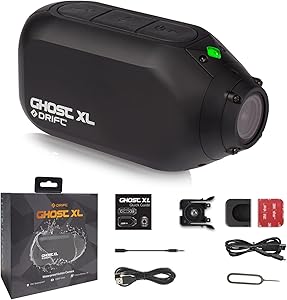
- Waterproof: IPX7 (fully waterproof out of the box)
- Video: 1080P HD
- Battery: 3000mAh — up to 9 hours continuous
- Angle: 140° super wide-angle
The DRIFT Ghost XL is engineered for endurance and reliability, built around a beefy 3000mAh battery that accommodates ultra-long recording sessions. Its IPX7 waterproofing straight from the unit (no case required) is a huge convenience for riders exposed to heavy rain or wet conditions. While it shoots at 1080p rather than 4K, the Ghost XL focuses on stable, long-duration capture with handy dash-cam features like Event Detection and Dash Cam Mode to protect critical moments and manage storage.
Image quality at 1080p remains clean and very usable for documenting rides, incidents, or scenic trips, and the 140° lens captures a broad field of view without over-warping the horizon. The Ghost XL excels when battery life and rugged reliability matter more than ultra-high resolution—for long touring days, multi-day rallies, or extended recording where charging options are limited, it’s a dependable, purpose-built choice.
- Pros: Exceptional battery life, waterproof without housing, built-in dash cam features.
- Cons: Limited to 1080p resolution; fewer advanced imaging modes than 4K competitors.
How to Choose Motorcycle Helmet Cameras
Motorcycle helmet cameras have become an essential tool for riders who want to record their journeys, improve safety, and relive thrilling road moments. Whether you ride daily through the city or take long weekend tours, a good helmet camera captures your perspective clearly and steadily. Choosing the right one depends on your riding style, budget, and the kind of footage you want. Below, we’ll go through all the key factors to consider when selecting the best motorcycle helmet camera for your needs.
Why You Need a Motorcycle Helmet Camera
Helmet cameras serve several purposes beyond just recording scenic routes. They provide evidence in case of accidents or disputes, act as deterrents against reckless drivers, and help improve your riding technique. Many riders also use them for vlogging or sharing their adventures online. The right camera delivers stable, high-quality footage and remains secure even at high speeds or during long rides.
Understanding Camera Resolution and Frame Rate
One of the first specifications you’ll encounter is video resolution. It determines how sharp and detailed your footage looks. Modern helmet cameras often support resolutions like 1080p, 2K, or 4K.
1080p (Full HD)
This is the most common option and provides good image quality for daily rides and safety recording. It also consumes less storage and battery power compared to higher resolutions.
2K and 4K
Higher resolutions like 2K and 4K offer more detail and clarity, especially when you want to edit or crop footage later. However, they require more storage and may drain the battery faster. If you enjoy capturing cinematic rides or vlog your journeys, a 4K camera is worth the investment.
Frame Rate and Smoothness
The frame rate, measured in frames per second (fps), affects how smooth your video appears. A rate of 30fps is standard for general use, while 60fps or higher delivers smoother motion—ideal for high-speed riding. Cameras offering multiple frame rate options give you flexibility depending on your recording needs.
Stabilization Technology
Road vibrations, wind, and bumpy terrain can ruin your footage if your camera lacks stabilization. Look for models featuring gyro stabilization or electronic image stabilization (EIS). These systems compensate for camera shake, resulting in smoother and more professional-looking videos. If you frequently ride on uneven roads or trails, stabilization is an absolute must.
Field of View (FOV)
The field of view determines how wide the camera captures the scene. Most helmet cameras offer between 120° and 170° FOV. A wider angle captures more of your surroundings, giving a more immersive perspective of the ride. However, extremely wide angles may distort the edges of the frame slightly. Choose a camera with an adjustable FOV if you want more control over your shot composition.
Mounting Options and Compatibility
Mounting flexibility is crucial because it affects both the camera’s stability and the view angle. Some riders prefer mounting on the side of the helmet, while others go for a top or chin mount for a true first-person perspective.
Mount Types
Most cameras come with adhesive mounts, clamps, or magnetic bases. Ensure the mount system is secure and vibration-resistant. Universal mounts are ideal if you plan to use the camera on different helmets or vehicles. Some premium models even include multiple accessories for various mounting positions.
Ease of Installation
Choose a camera that’s easy to install and adjust. You don’t want to spend time reattaching your camera every ride. Compact designs with quick-release mounts make removal and charging hassle-free.
Battery Life and Power Options
Battery life is one of the most important factors for long-distance riders. Look for cameras that last at least 2 to 3 hours on a single charge. For touring, models with removable batteries or support for charging while recording are excellent. Some advanced helmet cameras even connect directly to your motorcycle’s power supply via USB.
Durability and Weather Resistance
Riding exposes your camera to wind, dust, rain, and temperature changes. A durable design is essential for long-term reliability. Check the camera’s waterproof rating—models with IP67 or IP68 ratings can handle rain and submersion. Rugged construction also helps protect against accidental drops and debris impacts during high-speed rides.
Audio Quality and Microphone Options
Audio is just as important as video if you plan to record commentary or capture ambient road sounds. Internal microphones work well for casual use, but they may pick up wind noise. Look for models that support external microphones for clearer voice recording, especially if you vlog or use intercom systems. Wind reduction features or foam mic covers can also make a big difference.
Storage Capacity and Memory Cards
Helmet cameras use microSD cards to store footage. Choose a camera that supports at least 128GB, preferably 256GB, if you often record in 4K. Always use high-speed cards (UHS-I or UHS-II) to ensure smooth video capture without frame drops. Some cameras offer loop recording, which automatically overwrites the oldest files—handy for continuous dash cam use.
Connectivity and Smart Features
Modern helmet cameras often include wireless connectivity options like WiFi or Bluetooth. These allow you to preview footage, change settings, and transfer videos directly to your phone via an app. A few advanced models even feature GPS tracking, giving speed and route data for your recordings. Voice control and remote operation are also convenient if you prefer hands-free control while riding.
Night Vision and Low-Light Performance
Riding doesn’t always end when the sun goes down, so low-light performance matters. Cameras with large sensors and wide apertures handle night conditions better. Some include dedicated night modes or HDR (High Dynamic Range) to balance exposure during dawn, dusk, or under streetlights. If you ride frequently at night, prioritize a camera designed for enhanced low-light clarity.
Design and Weight
The camera’s size and weight affect helmet balance and comfort. Lighter, more aerodynamic cameras are ideal for minimizing wind drag and neck strain. Bulky models can feel awkward on long rides. Compact cameras like thumb-sized designs or cylindrical bodies tend to blend in better with your helmet, reducing both noise and resistance.
Price and Value for Money
Helmet cameras vary widely in price—from under $100 for budget options to over $300 for premium models. While cheaper cameras may cover basic needs, they often compromise on stabilization, battery life, or image quality. Mid-range cameras, around $150–$250, typically strike the best balance between features and performance. Always evaluate what features matter most for your riding style before buying.
Popular Features to Look For
- Dual-screen design for easy framing
- Voice control or one-touch recording
- Loop and time-lapse modes
- Remote control via wristband or app
- Pre-record and motion detection features
Tips for Mounting and Using Helmet Cameras Safely
When installing your helmet camera, make sure it doesn’t obstruct vision or compromise helmet safety. Always clean the surface before attaching mounts, and check them periodically to prevent loosening. Keep cables tidy and ensure the mount angle captures the road clearly without cutting off the horizon. Finally, familiarize yourself with the camera’s controls before riding so you can operate it safely and intuitively.
Final Thoughts
Choosing the right motorcycle helmet camera involves balancing video quality, durability, stabilization, and ease of use. Consider where and how you ride most often, and match the camera’s capabilities to those conditions. A well-chosen camera not only helps record stunning footage but can also enhance safety and confidence on the road. Whether you go for a high-end 4K model or a compact, budget-friendly option, the key is reliability—so your camera performs when it matters most.