Best Hitch Bike Racks for E-Bikes of 2026
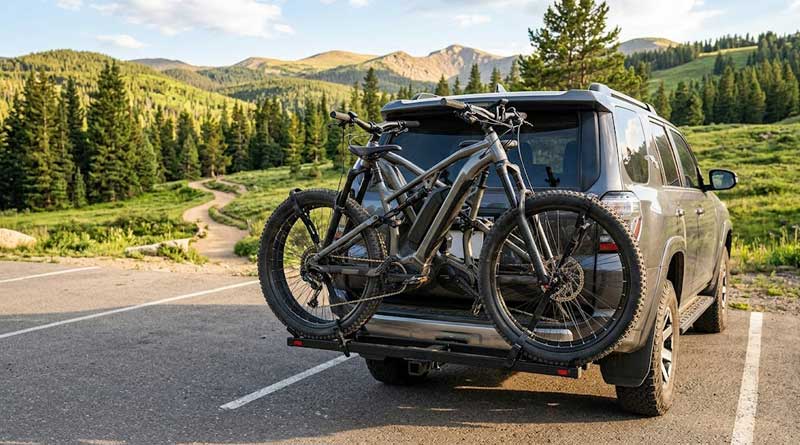
E-bikes are heavier than regular bikes, so you need a strong hitch rack to carry them safely. The best hitch bike racks for e-bikes are built to handle extra weight, fit fat tires, and make loading easy. In this article, we’ll break down the top options that are durable, simple to use, and kind to your frame—so you can hit the road with confidence.
1. Thule EasyFold XT

- Bike Capacity: 2 bikes, up to 65 lbs each
- Hitch Receiver: Fits 1.25″ or 2″ receivers
- Mounting Style: Platform with wheel attachment points
- Weight: 45 lbs with loaded tilt trunk access and integrated lock
The Thule EasyFold XT is a premium hitch rack built for cyclists who demand versatility and convenience. Its fully foldable design makes it easy to mount, handle, and store when not in use. Compatible with both electric and fat-tire bikes, it handles up to 65 lbs per bike, making it one of the most capable 2-bike racks in its class.
The platform-style mounting with wheel attachment points keeps frame contact minimal, protecting your bike’s finish. Trunk access via a loaded tilt mechanism means you don’t have to remove bikes to open your hatch. The integrated lock adds a layer of security that budget racks simply don’t offer. It’s a solid investment for frequent riders.
- Pros: Fully foldable design, supports e-bikes and fat-tire bikes, integrated lock, loaded tilt for trunk access
- Cons: No extension compatibility, 45 lb rack weight is on the heavier side
2. Swagman XC Cross-Country
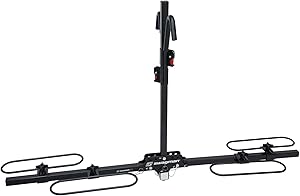
- Bike Capacity: 2 bikes, up to 35 lbs each
- Hitch Receiver: Class 2 or higher, fits 1-1/4″ and 2″
- Tire Compatibility: 20″ to 29″ tire sizes
- Key Feature: Built-in anti-wobble hitch device with foldable frame
The Swagman XC Cross-Country is a no-fuss, budget-friendly hitch rack that takes only minutes to assemble. Upright ratchet arms adjust to accommodate bike frames up to 59 cm (23.2″), making it a flexible option for households with multiple bike types. The built-in anti-wobble hitch device keeps everything stable and secure on the road.
Its foldable design saves valuable garage space when the rack isn’t in use, which is a practical bonus for everyday drivers. While the 35 lb per bike limit rules out heavier e-bikes, it’s well-suited for standard road and mountain bikes. Accessories like fat bike wheel trays and locking hitch pins are available separately for added versatility.
- Pros: Quick assembly, foldable for storage, anti-wobble system, affordable price point
- Cons: Low 35 lb per bike weight limit, no e-bike support without accessories, accessories sold separately
See the Swagman XC Cross-Country
3. Kuat Sherpa 2.0

- Bike Capacity: 2 bikes, up to 40 lbs each
- Hitch Receiver: Available in 1.25″ or 2″ versions
- Mounting Style: Platform with wheel attachment points
- Weight: 32 lbs with loaded tilt and integrated lock
The Kuat Sherpa 2.0 is a lightweight, well-engineered hitch rack that punches well above its weight class. Weighing just 32 lbs, it’s one of the lightest full-featured platform racks available. High-clearance, folding tire cradles make loading bikes smooth and stress-free, even for heavier mountain bikes with wider tires.
A pivot lever tilts the rack away from your vehicle for easy hatch or trunk access without unloading your bikes — a feature typically found on more expensive racks. The integrated lock secures both the bikes and the rack to your hitch, offering peace of mind at trailheads or parking lots. It’s a premium choice for minimalist-minded cyclists who won’t compromise on quality.
- Pros: Lightweight at 32 lbs, high-clearance folding cradles, loaded tilt access, integrated lock
- Cons: 40 lb per bike limit, no extension compatibility, premium price tag
4. Kuat Transfer v2

- Bike Capacity: 2 bikes; 40 lbs/bike (1.25″) or 60 lbs/bike (2″)
- Hitch Receiver: Available in 1.25″ or 2″ versions
- Bike Compatibility: Electric bikes and kids’ bikes
- Special Features: FlatLock™ hitch cam (2″ only), RV compatible (2″ only)
The Kuat Transfer v2 is a versatile, upgraded hitch rack designed to handle a wider range of bike sizes than its predecessor. The 2-inch version’s FlatLock™ hitch cam delivers exceptional stability, and the expanded weight capacity of 60 lbs per bike makes it one of the few mid-range racks capable of handling heavier electric bikes without issue.
Extension compatibility on the 2-inch version allows you to carry additional bikes down the road, and RV compatibility broadens its use cases significantly. Trunk access is unloaded only, which is a step down from loaded tilt racks, but the solid build quality and e-bike support make it a compelling option for growing families or multi-bike households looking for long-term value.
- Pros: Supports e-bikes and kids’ bikes, extension compatible (2″ version), RV compatible, FlatLock stability system
- Cons: Trunk access is unloaded only, features vary significantly between 1.25″ and 2″ versions
5. Thule T2 Pro XTR

- Bike Capacity: 2 bikes, up to 60 lbs each
- Hitch Receiver: Fits 1.25″ or 2″; extension compatible (2″ only)
- Bike Compatibility: Fat-tire, electric, and kids’ bikes
- Weight: 52 lbs with integrated lock and loaded tilt access
The Thule T2 Pro XTR is a top-tier platform rack that secures bikes with zero frame contact, protecting your investment from scratches and dings. At 60 lbs per bike capacity, it comfortably handles electric bikes, fat-tire bikes, and kids’ bikes — covering virtually every riding style in the family. Installation and removal require no tools, a genuine convenience for frequent users.
Built-in wheels make rolling the rack in and out of storage effortless despite its 52 lb weight. The loaded tilt function allows trunk access with bikes still mounted, and extension compatibility on the 2-inch version means you can grow the rack as your bike collection grows. It’s the benchmark rack for serious cyclists who want it all.
- Pros: No frame contact design, supports fat-tire and e-bikes, tool-free install, extension compatible (2″ version)
- Cons: Heaviest rack on this list at 52 lbs, premium price, extension only for 2″ version
6. Allen Sports Deluxe

- Hitch Receiver: Fits 2″ receivers only
- Mounting Style: Frame-mount with patented tie-down cradle system
- Key Features: No-wobble bolt, tilt-back for lift-gate access
- Finish: Black powder-coated steel construction
The Allen Sports Deluxe is a straightforward, dependable hitch rack designed for everyday cyclists who need reliable bike transport without the premium price tag. Its patented tie-down cradle system individually secures each bicycle, protecting frames during transport. The carry arms fold out of the way when not in use, keeping the hitch area tidy and vehicle-friendly.
A no-wobble bolt eliminates the annoying rattle that plagues lesser racks, and the tilt-back function provides easy rear hatch access without fully removing the rack. Retainer clips are attached with lanyards so you’ll never lose small parts mid-trip. It’s a solid, unpretentious rack for those who want function over flash at a wallet-friendly price.
- Pros: Budget-friendly, foldable carry arms, no-wobble bolt, tilt-back trunk access
- Cons: 2″ hitch only, frame-contact mounting style, no integrated bike lock
7. MaxxHaul Platform Bike Rack

- Bike Capacity: 2 bikes, up to 38 lbs each (75 lbs total)
- Hitch Receiver: Fits standard 2″ receivers; Class I–IV compatible
- Wheel Compatibility: 20″–26″ diameter, up to 2-1/4″ width; 63″ max wheelbase
- Key Feature: Removable vertical post for compact storage
The MaxxHaul Platform Bike Rack is a compact, capable option for cyclists looking for a platform-style rack at a budget price. Adjustable hooks and tire cradles accommodate wheel diameters from 20 to 26 inches, making it a practical fit for a range of standard road and mountain bikes. The built-in locking knob keeps the main upright secure, minimizing wobble on longer drives.
One of its standout features is the removable vertical post, which allows for notably compact storage when the rack isn’t in use — ideal for those with limited garage space. Not compatible with RVs, campers, or trailers, and the 38 lb per bike limit rules out heavier e-bikes. For standard recreational bikes, however, it delivers solid value for the price.
- Pros: Platform-style design, removable post for compact storage, Class I–IV compatibility, budget price
- Cons: 38 lb per bike limit, narrow wheel width accommodation (2-1/4″ max), not RV/trailer compatible
See the MaxxHaul Platform Bike Rack
8. Amazon Basics 4-Bike Hitch Rack

- Bike Capacity: 4 bikes, 132 lbs total capacity
- Hitch Receiver: Fits 2″ receivers; compatible with most cars, SUVs, and trucks
- Construction: Durable powder-coated steel with reinforced tie-downs
- Key Feature: Anti-rattle design with foldable frame for storage
The Amazon Basics 4-Bike Hitch Rack is a value-driven option for families or groups that need to haul multiple bikes without breaking the bank. It fits most cars, SUVs, and trucks via a standard 2-inch hitch, and the reinforced tie-downs keep bikes secure throughout the journey. The anti-rattle design noticeably reduces road noise compared to cheaper alternatives.
The foldable frame is a practical touch for space-efficient storage, and installation and removal are straightforward. Keep in mind that it’s not compatible with vehicles with rear-mounted spare tires and may interfere with backup cameras or sensors on some models. Hardware is included but stored in a small interior box — easy to miss during unboxing, so check before assembly.
- Pros: Carries 4 bikes, anti-rattle system, foldable frame, very affordable for 4-bike capacity
- Cons: Not compatible with rear spare tire vehicles, may block backup sensors, 2″ hitch only
See the Amazon Basics 4-Bike Hitch Rack
9. TANX Bike Rack for E-Bikes
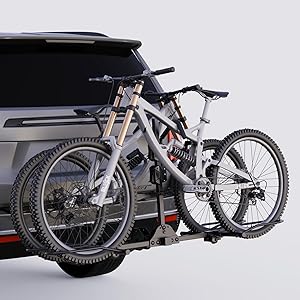
- Bike Capacity: 2 bikes, 160 lbs total capacity
- Hitch Receiver: Universal 2″ fit; compatible with SUVs, trucks, sedans, and RVs
- Tire Compatibility: Fat tires up to 5″ wide; wheelbase up to 59″
- Key Features: Anti-wobble hitch tightener, locking hitch pin, padded adjustable cradles
The TANX Bike Rack is purpose-built for e-bike and fat-tire bike owners who need serious carrying capacity. With a 160 lb total load rating and padded, adjustable cradles that accommodate tires up to 5 inches wide, it handles the heaviest modern bikes with ease. The anti-wobble hitch tightener and locking hitch pin combination keeps the setup rock-solid even on rough backroads.
The tilt mechanism provides full trunk access without unloading bikes, and the foldable frame keeps storage neat during off-season months. Soft padding on all contact points protects your bike’s finish and frame from scratches. RV and truck compatibility, combined with broad brand support including Ford, Toyota, and Jeep, make it one of the most universally compatible e-bike racks available.
- Pros: 160 lb capacity, e-bike and fat-tire ready, anti-wobble system, padded cradles protect finish
- Cons: 2″ hitch only, bulkier than standard racks, higher price for premium features
See the TANX Bike Rack for E-Bikes
10. MaxxHaul Hitch Mount 4 Bike Rack

- Bike Capacity: 4 bikes, 150 lbs total towing capacity
- Hitch Receiver: Fits 2″ x 2″ receivers; compatible with vans, SUVs, trucks, and sedans
- Construction: Rigid all-steel, powder-coated for durability
- Key Feature: Swing-down feature for rear vehicle access; includes hitch pin and reflector
The MaxxHaul Hitch Mount 4 Bike Rack is a rugged, all-steel carrier built to haul four bikes across long distances without complaint. The swing-down feature sets it apart from many competitors — rather than tilting, the rack swings down to give you effortless rear vehicle access without removing a single bike. Installation takes just minutes, and adjustable hold-down straps keep bikes secure throughout the trip.
An included reflector enhances road safety during evening travel, and the powder-coated finish ensures long-term durability against the elements. One important note: this rack is designed for bikes with a horizontal top bar frame. Step-through and non-standard frame styles will require a separate horizontal crossbar adapter. For traditional frame bikes, though, it’s a hard-to-beat value in the 4-bike segment.
- Pros: Swing-down rear access, 4-bike capacity, all-steel construction, includes reflector for safety
- Cons: Horizontal top bar frames only, no integrated lock, 2″ hitch only
See the MaxxHaul Hitch Mount 4 Bike Rack
11. Young 2 Bike Rack

- Bike Capacity: 2 bikes, up to 40 lbs each (80 lbs total)
- Hitch Receiver: Fits 2″ receivers; compatible with cars, SUVs, trucks, and RVs
- Frame Compatibility: Top tube frames only; not for step-through models
- Key Features: Anti-wobble device, safety latch, cushioned hooks, folding design
The Young 2 Bike Rack is a compact, heavy-duty steel rack designed for everyday cyclists hauling standard road or mountain bikes. Soft cushioned hooks wrap contact points to prevent rubbing and paint damage during transport — a small but appreciated detail. The safety latch and anti-wobble device work together to minimize movement on the road, even at highway speeds.
Adjustable knobs allow the bracket to accommodate bikes of varying sizes, giving it solid flexibility for households with multiple riders. The folding design collapses neatly for space-saving storage. One key limitation: this rack is designed for traditional top tube frames only and is not compatible with step-through or women’s geometry frames without an adapter crossbar. For compatible bikes, it’s a reliable and reasonably priced option.
- Pros: Heavy-duty steel build, cushioned hooks protect finish, anti-wobble system, foldable for storage
- Cons: Top tube frames only, 40 lb per bike limit, no integrated lock
12. Retrospec Lenox

- Hitch Receiver: Fits 2″ receivers; requires Class III or IV hitch
- Mounting Style: Frame-mount with individual cradles and tie-down straps
- Key Features: Anti-rattle adapter, foldable carry arms, downward-folding for hatch access
- Compatibility Note: Not for Retrospec e-bikes, RVs, trailers, or hitch adapters
The Retrospec Lenox is a clean, well-built hitch rack for cyclists who want simple, reliable bike transport. The carry arms fold downward, giving you access to your vehicle’s hatch without removing the rack from the hitch — a genuine convenience on day trips. Individual cradles and adjustable straps secure each bike independently, reducing the risk of frame-to-frame contact damage.
The anti-rattle adapter is a welcome inclusion that keeps road noise and vibration in check over long hauls. Its foldable design means compact, no-fuss storage when the rack is off-season. Note that it requires a Class III or IV hitch, which limits compatibility with smaller vehicles. It also cannot be used with Retrospec’s own e-bike lineup, which is an odd omission worth noting before purchase.
- Pros: Anti-rattle adapter, foldable carry arms, individual cradle system, clean aesthetic
- Cons: Requires Class III or IV hitch, not compatible with e-bikes or RVs, frame-contact mounting
13. MaxxHaul 50025

- Bike Capacity: 2 bikes, up to 50 lbs each (100 lbs total)
- Hitch Receiver: Fits 1-1/4″ and 2″; Class I–IV compatible
- Mounting Style: Frame-mount with rubber bike cradles and buckle straps
- Key Feature: Built-in locking knob for anti-wobble stability
The MaxxHaul 50025 is a dependable dual-hitch-size rack that offers broad vehicle compatibility at an accessible price point. Fitting both 1-1/4″ and 2″ receivers, it works across Class I through IV hitches, making it one of the more universally compatible options in its price range. Rubber bike cradles and buckle-type straps keep bikes snug and protected during transport.
The built-in locking knob minimizes rack wobble, a common complaint with budget frame-mount designs. With a generous 100 lb total capacity — 50 lbs per bike — it handles most standard bikes comfortably. Like many frame-mount racks, it’s designed for horizontal top bar frames; alternative frame styles require an additional crossbar. A minor note: pad color may vary slightly between units, a cosmetic quirk rather than a functional concern.
- Pros: Fits 1-1/4″ and 2″ hitches, broad Class I–IV compatibility, 100 lb total capacity, budget-friendly
- Cons: Horizontal top bar frames only, frame-contact mounting, no integrated lock
14. WEIZE 2-E-Bike Rack
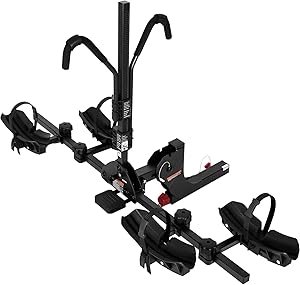
- Bike Capacity: 2 bikes, up to 80 lbs each (160 lbs total)
- Hitch Receiver: 2″ only; compatible with cars, trucks, SUVs, and minivans
- Tire Compatibility: 17″–29″ wheels, up to 5.5″ fat tires; 18.5″–49.5″ wheelbase
- Key Features: Key-lock anti-wobble, smart tilt, folding platform, anti-scratch cradles
The WEIZE 2-E-Bike Rack is engineered from the ground up for electric bike transport. With an 80 lb per bike capacity and support for fat tires up to 5.5 inches wide, it’s one of the most capable racks for heavy e-bikes and oversized tire setups. The key locking device tightens the rack into the hitch receiver for a wobble-free, theft-resistant installation.
Soft locking frame clamps and gear locking straps secure each bike without scratching the finish, and a safety strap provides additional protection to surrounding paintwork. The tilting function allows full trunk access with bikes loaded — a crucial convenience for e-bike users who don’t want to wrestle heavy bikes on and off for a quick gear grab. A 1-year warranty rounds out a well-thought-out package.
- Pros: 160 lb total capacity, 5.5″ fat tire support, anti-wobble key lock, loaded tilt access
- Cons: 2″ hitch only, step-through frames require separate crossbar, not suitable for swing-out tailgates
15. Yakima DoubleDown

- Bike Capacity: 4 bikes, up to 30 lbs each (120 lbs total)
- Hitch Receiver: Fits 1.25″ and 2″ receivers; compatible with cars, SUVs, trucks, and trailers
- Bike Compatibility: Road, mountain, and hybrid bikes; TubeTop required for non-standard frames
- Key Features: Tilt-down mechanism for rear access; optional DeadLock security system
The Yakima DoubleDown is a tried-and-true 4-bike hitch rack from one of the most respected names in outdoor gear. Accommodating 1.25″ and 2″ hitches, it’s broadly compatible with a wide range of vehicles including cars, SUVs, trucks, and trailers. The heavy-duty build delivers on-road stability, while the tilt-down mechanism provides convenient access to the rear of your vehicle without unloading bikes.
Compatibility with the optional DeadLock system allows you to add lockable security to both the bikes and the rack itself. However, it’s worth noting that e-bikes are not supported, and non-conventional frames — including step-through, BMX, and some full suspension styles — require the separately sold TubeTop adapter. For traditional bike riders who need 4-bike capacity, it’s one of the most reputable options available.
- Pros: 4-bike capacity, fits 1.25″ and 2″ hitches, trailer compatible, optional DeadLock security
- Cons: Not e-bike compatible, 30 lb per bike limit, TubeTop adapter sold separately for non-standard frames
The Ultimate Guide to Choosing Hitch Bike Racks for E-Bikes
Electric bicycles, or e-bikes, have transformed the world of cycling. By lowering the barriers of fitness, distance, and terrain, they have allowed millions of riders to hit the roads and trails. However, transporting these innovative machines presents a unique logistical challenge. Because e-bikes are significantly heavier and often structurally bulkier than traditional bicycles, a standard bicycle rack will not suffice. To safely transport an electric bike on the back of a vehicle, a specialized hitch-mounted bike rack is almost always mandatory.
Selecting the right hitch rack for an e-bike requires an understanding of weight limits, frame geometries, vehicle specifications, and security features. Failing to choose an appropriate rack can result in structural damage to your vehicle, destruction of your expensive e-bikes, or catastrophic failure on the highway. This article provides an exhaustive analysis of how to choose the perfect hitch bike rack tailored specifically for e-bikes.
Understanding the E-Bike Weight Factor
The single most important variable when shopping for an e-bike hitch rack is weight capacity. A standard acoustic mountain bike or road bike typically weighs between 15 and 35 pounds. In contrast, an average e-bike weights anywhere from 45 to 75 pounds, driven largely by the heavy electric motor and lithium-ion battery pack. Cargo e-bikes or fat-tire utility models can easily exceed 80 pounds.
Before looking at rack designs, you must weigh your e-bikes accurately. Note their weight both with and without the batteries installed. Many riders choose to remove the battery during transport to reduce the overall payload on the rack, which can shave off 7 to 10 pounds per bicycle. Once you have a definitive weight, you must ensure that the rack’s per-bike weight limit comfortably accommodates your heaviest bike.
Hitch Receiver Classes and Tongue Weight Limits
It is not enough for the bike rack itself to be strong; your vehicle’s hitch receiver must also be rated to carry the combined weight of the rack and the e-bikes. Hitches are categorized into classes based on their towing and tongue weight capacities:
- Class 1 (1.25-inch receiver): Typically limited to a 200-pound tongue weight. These are generally unsafe for carrying multiple e-bikes, as the leverage exerted by a heavy rack and two e-bikes can bend the receiver or vehicle frame.
- Class 2 (1.25-inch receiver): Often rated for up to 300–350 pounds of tongue weight. While stronger, they are still limited by the smaller 1.25-inch shank size, which is prone to excessive wobble under heavy loads.
- Class 3 and Higher (2-inch receiver): The gold standard for e-bike transportation. Rated for 500 to 1,000+ pounds of tongue weight, a 2-inch receiver provides the structural rigidity and physical dimensions required to handle heavy-duty e-bike platforms.
Always verify your vehicle’s maximum tongue weight rating in the owner’s manual. Remember that tongue weight refers to the downward static force applied to the hitch, which is the total weight of the rack plus the weight of all loaded e-bikes.
Platform Racks vs. Hanging Racks
Hitch-mounted racks generally fall into two categories: hanging style and platform style. For e-bikes, the choice is clear and absolute.
Why Hanging Racks Fall Short
Hanging racks support bicycles by their top tubes, leaving the wheels dangling. These are completely unsuited for e-bikes for three reasons. First, they rarely feature individual per-bike weight capacities exceeding 35 or 40 pounds. Second, lifting a 60-pound e-bike high enough to slide it onto hanging cradles is ergonomically difficult and presents a high risk of injury. Third, because e-bikes often feature step-through frames or unique battery placement configurations, they frequently lack a conventional top tube, necessitating an additional adapter bar that introduces dangerous structural play.
The Superiority of Platform Racks
Platform racks (or tray racks) support the bicycles from underneath via their tires. The bike is rolled or lifted onto a tray, and the weight is distributed evenly across the base of the rack. Platform style racks are the only viable choice for e-bikes because they boast much higher weight ratings, offer superior stability, minimize bicycle-to-bicycle contact, and keep the loading height significantly closer to the ground.
Key Features to Evaluate in an E-Bike Platform Rack
Once you narrow your search to platform-style hitch racks with a 2-inch shank, several sub-features dictate usability, safety, and longevity.
Frame Contact vs. Wheel-Only Retention
Platform racks secure bicycles using one of two primary mechanisms: frame clamps or ratcheting front-wheel arms.
Frame-clamping racks use a vertical post with padded hooks that clamp down tightly on the e-bike’s top tube or down tube. While functional, they can crush thin-walled aluminum or carbon fiber frames if overtightened. Furthermore, integrated frame batteries often make it difficult to find a safe clamping location without interfering with electrical components.
Wheel-only retention racks secure the bike by clamping a heavy-duty arm over the front tire and securing the rear wheel with a strap. These are highly recommended for e-bikes because they make absolutely zero contact with the bicycle frame. This preserves the paint, eliminates the risk of structural frame damage, and easily accommodates step-through or unconventional e-bike geometries.
Loading Ramps and Accessibility
Lifting a 60-pound dead weight into a rack tray can be difficult, especially on taller vehicles like SUVs or trucks. To solve this problem, premium e-bike racks include integrated or add-on loading ramps. These ramps attach to the edge of the tray, allowing you to walk or roll the e-bike up onto the rack using its walk-assist motor mode. If lifting heavy objects is a physical constraint for you, a ramp is a non-negotiable feature.
Tire Tray Width and Spacing
E-bikes frequently utilize wider tires to handle their increased weight and speed. Many fat-tire e-bikes feature tire widths between 3 and 5 inches. Ensure that the wheel cradles or trays on your chosen rack are wide enough to seat your tires deeply. Many manufacturers sell fat-tire strap kits or wider replacement cradles separately if the stock configuration is designed for standard mountain or road tires. Additionally, ensure there is sufficient spacing between the trays (pitch) to prevent the handlebars of one bike from smashing into the saddle or display screen of the adjacent bike.
Tilt and Fold Functionality
A loaded bike rack blocks access to your vehicle’s trunk, hatch, or tailgate. To combat this, look for a platform rack that features a tilting mechanism. A quality rack will tilt downward away from the vehicle even when fully loaded with e-bikes, allowing you to open your rear hatch without unloading the bikes. Ensure the tilt lever is located at the outer edge of the rack rather than deep near the hitch pin, as reaching through heavy e-bikes to pull a release pin can be awkward and unsafe. When no bikes are loaded, the rack should also fold up vertically against the rear bumper to minimize the vehicle’s footprint while parking.
Security and Theft Prevention
E-bikes represent a massive financial investment, often costing thousands of dollars apiece. They are prime targets for opportunistic thieves at trailheads, hotel parking lots, and rest stops. A robust security system is critical. Look for racks that incorporate heavy-duty integrated locking cables or chains that secure the bike frames directly to the structural core of the rack. Additionally, the rack itself must be locked to your vehicle’s hitch receiver using a locking hitch pin to prevent someone from stealing the entire assembly, bikes included.
Conclusion
Choosing a hitch bike rack for e-bikes is a matter of safety and structural compatibility rather than personal aesthetics. Always prioritize a platform-style rack engineered specifically for a 2-inch hitch receiver, and ensure its certified weight capacity exceeds the actual weight of your e-bikes. By paying close attention to loading mechanisms, tire clearances, frame contact points, and locking features, you can confidently protect your e-bike investment and enjoy hassle-free transportation to your next cycling destination.