Best Motorcycle Boots for Street Riding of 2026
If you ride a motorcycle on the street, your feet need solid protection. Regular shoes just won’t cut it. The best motorcycle boots for street riding combine safety, comfort, and a look you can wear all day. This guide breaks down top picks that guard your ankles, grip the pavement, and handle shifting gears with ease—without feeling like heavy space boots.
1. Zeozoom Motorcycle Riding Boots
- Sole Material: Rubber
- Shaft Height: Calf High
- Shaft Circumference: 10.5 Inches
- Outer Material: Leather
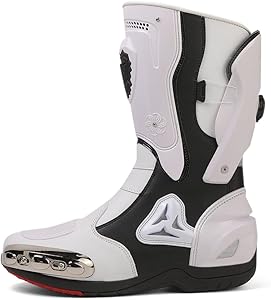
The Zeozoom Motorcycle Riding Boots are built for both men and women who demand reliable protection on the road. The full leather upper provides a rugged exterior capable of resisting abrasion, while the rubber sole delivers dependable grip across varied surfaces. The calf-high shaft and 10.5-inch circumference ensure a snug yet comfortable fit that supports the ankle through long rides.
These boots strike a practical balance between protection and style, making them suitable for daily commuting as well as recreational riding. The anti-slip design adds confidence during adverse weather conditions, and the classic motorcycle silhouette transitions naturally from the road to casual settings.
Pros:
- Genuine leather upper for durability
- Anti-slip rubber sole for reliable traction
- Unisex design suitable for men and women
Cons:
- Limited technical protection features compared to racing boots
- May require a break-in period
See the Zeozoom Motorcycle Riding Boots
—
2. NORTIV 8 Boots

- Midsole: Responsive EVA for shock absorption
- Outsole: Rubber with specialized tread pattern
- Shaft Height: 8–9 Inches
- Upper Material: Flexible Oxford cloth
The NORTIV 8 Military Tactical Boot is engineered for men who need all-day comfort and versatility. The responsive EVA midsole absorbs impact effectively, while the breathable mesh lining and footbed maintain dryness throughout extended wear. A contoured insole cradles the arch, and the padded collar provides enhanced ankle security, making these boots equally suited for motorcycle riding and heavy-duty work.
Built with seamless construction for maximum durability, these lightweight boots feature a high-quality side zipper and heel pull loop for effortless on/off. The rubber outsole with its purpose-designed tread ensures grip on wet, uneven, and slippery surfaces, making them a dependable option for security professionals and outdoor enthusiasts alike.
Pros:
- Lightweight yet durable seamless construction
- Excellent shock absorption via EVA midsole
- Side zipper for quick and easy wear
Cons:
- Not CE-certified for motorcycle protection
- Oxford cloth upper may wear faster than leather
—
3. O’NEAL Dirt Bike Boot
- Closure System: Four-buckle snap-lock adjustable
- Protection: Injection-molded plastic plates and metal shank insert
- Interior: Air mesh with cushioned insole
- Heat Protection: Synthetic leather heat shield
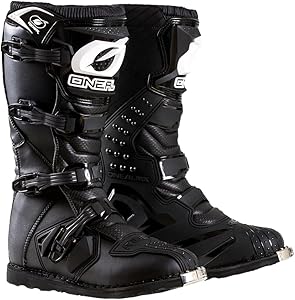
The O’NEAL Dirt Bike Boot is a purpose-built off-road boot designed to withstand the rigors of motocross and trail riding. Injection-molded plastic plates guard against impacts, while a metal shank insert reinforces the boot’s structure and provides additional underfoot support. The four-buckle snap-lock closure system is intuitive and quick to operate, ensuring a secure fit even in demanding conditions.
Inside, an air mesh interior promotes breathability, and the generously cushioned insole reduces fatigue during long sessions. The synthetic leather heat shield protects against exhaust and engine heat. Note that O’NEAL recommends sizing up half a size since boots are offered in whole sizes only.
Pros:
- Injection-molded plates for superior impact protection
- Adjustable four-buckle closure for a secure fit
- Heat shield prevents exhaust damage
Cons:
- Only available in whole sizes
- Bulkier design less suitable for street use
—
4. Timberland PRO Direct Attach

- Upper: Waterproof leather with seam-sealed construction
- Insulation: 200g Thermolite
- Outsole: TPU with MaxTRAX slip-resistant tread
- Compliance: ASTM F2892-24 EH SRO certified
The Timberland PRO Direct Attach is a premium work and riding boot that combines serious weatherproofing with all-day comfort. The waterproof leather upper and seam-sealed construction keep feet completely dry, while 200 grams of Thermolite insulation provides reliable warmth in cold conditions. The Timberland PRO 24/7 comfort system and PU midsole work together to significantly reduce foot fatigue over extended wear.
The nonmarking TPU outsole features MaxTRAX patented tread, offering outstanding slip, oil, and abrasion resistance across a variety of surfaces. Compliance with ASTM F2892-24 EH SRO standards makes this boot a trustworthy choice for both professional environments and motorcycle commuting where dependable footing is non-negotiable.
Pros:
- Fully waterproof with Thermolite insulation
- MaxTRAX outsole for superior slip resistance
- ASTM-certified for safety compliance
Cons:
- Heavier than non-insulated alternatives
- Work-boot styling may not appeal to all riders
See the Timberland PRO Direct Attach
—
5. Vostey Boots for Men

- Shaft Height: 6.8 Inches
- Heel Height: 1.2 Inches
- Weight: 1.1 lbs per boot
- Closure: Lace-up with inside zipper
The Vostey Men’s Combat Motorcycle Boot blends modern street style with practical riding functionality. Premium materials give the upper a smooth, glossy finish and a naturally waterproof surface, while the padded collar delivers multi-directional ankle support. The combination of a lace-up front and interior zipper ensures both a customizable fit and effortless on/off convenience throughout the day.
Weighing just 1.1 lbs per boot, these are among the lighter options in the motorcycle boot category, reducing leg fatigue without sacrificing durability. The rubber sole with non-slip tread provides reliable grip, and the soft lining eliminates any uncomfortable break-in period, making them ready to wear straight out of the box.
Pros:
- Exceptionally lightweight at 1.1 lbs per boot
- No break-in period required
- Dual lace-up and zipper closure system
Cons:
- Minimal technical protective features
- Slight sizing variation due to hand measurement
—
6. BORLENI Motorcycle Riding Shoes

- Upper: Leather and breathable fabric combination
- Protection: PP ankle and heel protective shell with reflective inserts
- Toe Cap: Thickened microfiber gear-shift protection
- Closure: Side zipper design
The BORLENI Motorcycle Riding Shoes are a strong choice for riders who want protection without sacrificing everyday wearability. The PP protective shell around the ankle and heel delivers all-round strategic coverage, while integrated reflective inserts enhance visibility in low-light conditions — a feature often overlooked in casual riding shoes. Two pairs of laces allow for a personalized fit with any riding accessory.
The thickened, wear-resistant toe cap with microfiber gear-shift protection is a standout detail that sets these shoes apart from standard lifestyle footwear. The rubber anti-skid sole ensures stability across surfaces, and the convenient side zipper makes putting them on and taking them off a fast, hassle-free experience during daily commutes.
Pros:
- PP shell protection at ankle and heel
- Reflective inserts for improved night visibility
- Dedicated gear-shift toe protection
Cons:
- Not CE-certified for formal motorcycle protection rating
- Street-style look may not suit aggressive riding
See the BORLENI Motorcycle Riding Shoes
—
7. Bofucn Motorcycle Leather Boots

- Sole Material: Rubber
- Shaft Height: Ankle
- Shaft Circumference: 10.5 Inches
- Outer Material: Leather
The Bofucn Motorcycle Leather Boots offer a compact, ankle-height profile that suits riders preferring a less bulky riding footwear option. The genuine leather upper provides natural abrasion resistance and a classic aesthetic that works well both on and off the bike. A 10.5-inch shaft circumference accommodates a wide range of calf sizes without feeling restrictive.
The rubber sole ensures adequate grip on common road surfaces, and the leather construction is expected to develop a comfortable fit over time with regular use. These boots are a solid entry-level choice for casual riders who want authentic leather quality at an accessible price point, particularly for urban commuting and short-distance rides.
Pros:
- Genuine leather upper for long-term durability
- Ankle-height design for ease of movement
- Rubber sole for reliable traction
Cons:
- Limited product specifications provided
- May require a break-in period typical of leather boots
See the Bofucn Motorcycle Leather Boots
—
8. Jousen Casual Motorcycle Boot
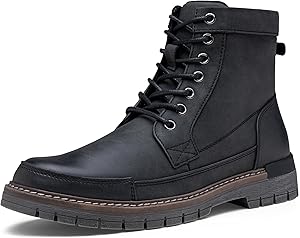
- Insole: Removable memory foam with arch support
- Outsole: Rubber with non-slip tread pattern
- Closure: Inner zipper with lace-up design
- Collar: Thickened padded collar for ankle protection
The Jousen Casual Motorcycle Boot is a versatile option designed to transition comfortably between everyday wear, outdoor activities, and motorcycle riding. The standout feature is its removable memory foam insole, which provides excellent arch support and cushioning for all-day comfort without requiring any break-in time. The thickened padded collar offers multi-dimensional ankle protection that riders will appreciate during longer journeys.
The inner zipper makes wearing and removing the boots effortless, while the rubber outsole with a non-slip tread pattern handles uneven terrain reliably. Jousen offers these boots in a wider fit option, making them an inclusive choice for riders with broader feet who often struggle to find comfortable motorcycle-ready footwear in standard sizing.
Pros:
- Removable memory foam insoles for superior comfort
- Available in wider fit for broader feet
- Versatile for riding, hiking, and casual wear
Cons:
- Casual styling offers minimal technical riding protection
- Sizing runs slightly roomy per manufacturer
See the Jousen Casual Motorcycle Boot
—
9. WIDEWAY Tactical Boots
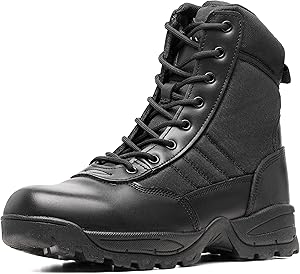
- Upper: 1.88mm full-grain leather with 1000D tear-resistant nylon
- Outsole: Pure rubber with directional outer lugs
- Insole: 7mm thick cushioned for impact absorption
- Closure: YKK side zipper with 8-eyelet speed lacing
The WIDEWAY Tactical Boot is engineered for professionals and riders who demand extreme durability and structural reliability. The 1.88mm full-grain leather upper, reinforced with 1000D tear-resistant nylon, far surpasses thin synthetic alternatives in abrasion resistance and long-term wearability. The YKK side zipper paired with an 8-eyelet speed lacing system provides rapid entry while keeping debris and grit out effectively.
Underfoot, a 7mm cushioned insole and precision-molded construction with steel paper heel reinforcement deliver exceptional arch and heel support, resisting deformation even after prolonged heavy-duty use. The pure rubber outsole with directional lugs and deep grooves handles all terrain confidently, from wet urban streets to muddy off-road trails, making these boots a serious performer across varied environments.
Pros:
- Premium 1.88mm full-grain leather construction
- Heavy-duty YKK zipper for rapid, secure entry
- Steel heel reinforcement prevents deformation
Cons:
- Heavier build than casual motorcycle footwear
- Tactical styling may not suit all riders
See the WIDEWAY Tactical Boots
—
10. RIDEIRON Motorcycle Shoes
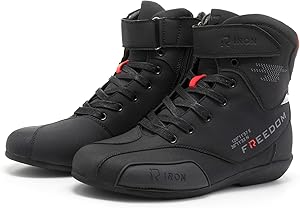
- Certification: CE EN 13634:2017 (Clause 0598/PPE/25/5857)
- Closure: Metal side zippers with Velcro fasteners
- Protection Zones: Reinforced heel cap, ankle support, wear-resistant toe with shift pad
- Visibility: Integrated reflective elements for night riding
The RIDEIRON Motorcycle Shoes stand out as the only CE-certified option in this lineup, carrying EN 13634:2017 certification — a meaningful safety benchmark for motorcycle footwear. The advanced anti-slip profile maintains grip on wet, oily, and uneven surfaces, while reinforced heel, dampening ankle support, and a wear-resistant toe with a gear-shift pad protect all critical foot zones during a ride.
Integrated reflective elements and high-visibility accents improve rider recognition at dusk and nighttime, adding a passive safety layer that many competing shoes overlook. The high-top design features stable metal side zippers and Velcro fasteners for a precise, secure fit, while breathable upholstery and flexible lightweight protective elements on the shin, ankle, and midfoot ensure long-term wearing comfort without compromising safety.
Pros:
- CE EN 13634:2017 certified for verified protection
- Reflective elements enhance night-time visibility
- Comprehensive protection across heel, ankle, and toe
Cons:
- High-top cut may feel restrictive for some riders
- Sport styling less versatile for off-bike casual wear
See the RIDEIRON Motorcycle Shoes
How to Choose Motorcycle Boots for Street Riding: A Comprehensive Guide
For street motorcyclists, gear selection often begins and ends with a high-quality helmet and a sturdy jacket. While these are critical components of a rider’s safety toolkit, the feet and ankles are frequently underserved, left vulnerable in standard sneakers or work boots. In the event of a mishap, the lower extremities are among the most statistically likely areas of the body to sustain injuries. Choosing the right motorcycle boots for street riding is not merely a matter of aesthetic coordination; it is a critical decision that directly impacts your control over the machine, your comfort during long hours in the saddle, and your physical protection if you ever meet the asphalt.
Street riding presents a unique set of challenges compared to track racing or dirt riding. A street rider needs a boot that offers robust protection against impacts and abrasion, yet remains comfortable enough to walk in, weather-resistant enough to handle sudden downpours, and stylish enough to wear in casual social settings. Navigating these overlapping requirements requires an understanding of structural engineering, material science, and ergonomics.
The Anatomy of Protection: What Makes a Boot Safe
To understand why specialized footwear is necessary, one must look at the specific mechanics of a motorcycle accident. The feet and ankles are subject to severe twisting forces (torsion), heavy crushing impacts from the motorcycle itself, and extreme friction from sliding across coarse pavement. Standard footwear fails completely under these conditions; laces shred, soles tear away, and thin leather or canvas offers zero resistance to impact or abrasion.
Ankle Stabilization and Torsional Resistance
The human ankle is a complex joint that is highly susceptible to fractures and dislocations when forced beyond its natural range of motion. High-quality street riding boots feature built-in ankle protection, often consisting of molded thermoplastic polyurethane (TPU) discs or cups embedded on both the medial (inner) and lateral (outer) sides of the joint. These inserts absorb impact energy from a side-swipe or fall. Advanced street boots may also incorporate a mechanical brace or ankle-control system that allows for normal forward and backward flexing (essential for shifting and braking) while strictly limiting sideways twisting, thereby preventing catastrophic hyperextension or torsion injuries.
Crush Protection and Sole Rigidity
A common street riding scenario involves the motorcycle falling on top of the rider’s leg and foot. To prevent the bones of the foot from being crushed by hundreds of pounds of metal, motorcycle boots utilize a reinforced shank within the sole. This shank, traditionally made of steel but increasingly constructed from rigid composite materials or molded nylon, runs from the heel to the ball of the foot. It ensures that the sole remains rigid when subjected to lateral compression, while still allowing enough flex at the toes to make walking manageable. A simple test of a boot’s structural integrity is to try to twist or bend the sole; if it flexes as easily as a running shoe, it will not protect your foot in a crush scenario.
Reinforced Toe Boxes and Heel Counters
The front and back of the foot require dedicated armor. The toe box of a riding boot is heavily reinforced with hardened plastics or composites to shield your toes from forward impacts and to prevent the front of the foot from being compressed. This reinforcement also provides a stiff platform for operating the gear shifter day after day without causing pain or premature wear to the boot. Similarly, a rigid heel counter wraps around the back of the foot, stabilizing the heel and absorbing rearward impact forces during a slide or tumble.
Material Matters: Balancing Durability and Comfort
The outer shell of a motorcycle boot serves as the primary barrier against abrasion. While technology has introduced many innovative materials to the market, traditional leather and modern synthetic microfibers remain the two dominant choices for street riders.
Full-Grain Leather vs. Synthetic Microfibers
Full-grain leather is the gold standard for abrasion resistance. It possesses natural tensile strength, conforms beautifully to the shape of the rider’s foot over time, and develops a distinct patina. However, leather requires regular maintenance, can absorb water if not treated, and can be heavy. Synthetic microfibers, on the other hand, are engineered to match or exceed the abrasion resistance of leather while offering superior consistency. Microfibers are lighter, inherently more water-resistant, require less break-in time, and do not degrade as quickly when exposed to the elements. Both materials are excellent choices, provided they meet minimum thickness and construction quality standards.
Fastening Systems: Security and Convenience
How a boot stays on your foot is just as important as the material it is made of. In an accident, the violent forces can easily rip a loose shoe clean off your foot. Traditional laces are common on casual, sneaker-style street boots, but they present a hazard if they catch on the footpegs, shifter, or brake pedal. Riders choosing laced boots should look for models with a dedicated ankle strap or lace pocket to secure the excess loops. Zippers offer quick entry and exit, but they should always be backed by a heavy-duty hook-and-loop flap to protect the zipper track from abrasion and to ensure the boot stays closed during a slide. Buckle systems, derived from racing and off-road boots, provide the most secure fit and allow for precise adjustments, though they add bulk to the boot’s profile.
Categorizing Street Riding Boots
Street riding encompasses everything from short daily commutes to long-distance weekend tours. Manufacturers cater to these diverse needs by offering boots across a spectrum of styles, each balancing protection, comfort, and aesthetics differently.
Short/Ankle-Length Riding Shoes
Designed for the urban commuter who needs to transition seamlessly from the bike to an office or university campus, these riding shoes look like everyday high-top sneakers or skate shoes. Despite their casual appearance, they include hidden TPU ankle discs, reinforced toe and heel boxes, and a stiffened sole. While they offer significantly more protection than normal footwear, they lack the shin coverage and advanced torsional support of full-height boots.
Sport and Track-Inspired Boots
For aggressive street riders or those who enjoy canyon carving, sport boots offer high-level protection derived from professional racing gear. These are full-height boots featuring external TPU sliders, comprehensive shin guards, and rigid ankle bracing systems. They offer maximum protection against high-speed slides and impacts, but their stiffness and loud, squeaky plastics make them less practical for walking around at your destination.
Touring and ADV Boots
Touring boots prioritize long-distance comfort and absolute weather protection. They are usually mid-to-full height, constructed from heavy-duty leather or microfiber, and almost always incorporate a waterproof, breathable membrane like Gore-Tex. These boots feature subdued styling that fits cleanly under riding jeans or textile pants. They offer excellent impact protection and are comfortable enough to wear through a full day of riding and light hiking, making them the most versatile choice for the serious street rider.
Fitment, Sizing, and Long-Term Care
Even the most advanced boot will fail to protect you if it does not fit correctly. When trying on motorcycle boots, wear the specific socks you intend to ride in. The boot should feel snug around the heel and midfoot, with enough room in the toe box to wiggle your toes slightly. Your foot should not slide forward or backward inside the boot when you walk, and your heel should not lift excessively.
Keep in mind that high-quality leather boots will stretch and mold to your feet slightly during a break-in period of a few weeks, whereas synthetic boots will generally maintain their out-of-the-box fit. Sit on a motorcycle, if possible, to ensure the boot allows for comfortable manipulation of the shift lever and rear brake without pinching or restricting circulation.
Finally, maintaining your investment is crucial for preserving its protective qualities. Clean off road grime, salt, and dead bugs regularly with a damp cloth. For leather boots, apply a quality conditioner every few months to prevent drying and cracking. If your boots get soaked during a rainy ride, allow them to air dry naturally away from direct heat sources like radiators or hair dryers, which can warp the internal plastics and ruin the leather fibers. By selecting the right boot and caring for it properly, you ensure that your feet remain protected, comfortable, and ready for whatever the open road throws your way.