Best Road Bike Helmets with Visors of 2026
A good road bike helmet with a visor can make your rides safer and more comfortable. It protects your head during accidents. The visor shields your eyes from sun, wind, and dust. Many helmets also improve visibility and help you focus on the road. Choosing the right one can feel confusing because there are many options. Each helmet offers different features and levels of protection. This guide will help you understand what matters most. It will make your decision easier. And it will help you ride with more confidence.
1. tadpole Bike Helmet

- Construction: One-piece EPS & PC shell for shock absorption.
- Features: Magnetic helmet goggles and integrated visor.
- Lighting: USB rechargeable rear light with 3 modes (Steady, Flashing, Blinking).
- Fit & Comfort: Breathable design with removable and washable mesh lining.
The tadpole Bike Helmet positions itself as a versatile, all-in-one solution for the urban commuter or recreational rider. Its standout feature is the combination of magnetic goggles and a visor, designed to offer comprehensive eye and face protection from sun, wind, and debris without needing separate accessories. The integrated rear light is a significant safety boost for city or dusk riding, enhancing visibility to traffic with multiple flashing modes.
Comfort is addressed through a vented design aimed at channeling airflow to keep you cool, and the lightweight build promises comfort on longer rides. However, the product note about electronic components not being 100% guaranteed hints at potential durability concerns with the light module. It’s a feature-packed helmet that seems best suited for casual cycling and commuting where the integrated visor and goggles provide clear added value.
- Pros: Integrated magnetic goggles and visor; Good visibility with rechargeable rear light
- Cons: Potential reliability issues with the electronic light; Lacks multiple safety certification mentions
2. ILM Bike Helmet

- Safety Certs: Certified by ASTM, CPSC, CE, and EN1078.
- Lighting System: USB rechargeable front and rear lights with 4 modes.
- Ventilation: 10 strategically placed vents for active cooling.
- Fit System: Size adjustment dial and detachable tinted lens.
The ILM Bike Helmet is a strong contender in the feature-rich commuter helmet category, backed by an impressive array of safety certifications. Its dual lighting system is a major highlight, providing not only a rear safety beacon but also a functional front light, which is somewhat rare in helmet designs. This makes it an excellent choice for riders who frequently travel in low-light conditions or at night, offering both illumination and enhanced visibility.
With ten vents and a breathable liner, it focuses on keeping you cool, while the adjustment dial ensures a secure, personalized fit. The inclusion of a detachable tinted lens adds versatility for changing light conditions. The main trade-off for these extensive features is likely a slight increase in weight and complexity compared to a minimalist road helmet. It’s a comprehensive package for the safety-conscious urban cyclist.
- Pros: Comprehensive safety certifications; Dual front and rear rechargeable lights
- Cons: Likely heavier than basic helmets; More features can mean more potential points of failure
3. Odoland Bike Helmet

- Visor: Magnetic & removable sun visor for UV/wind/dust protection.
- Fit: One-size-fits-most (54-62cm) with a dial adjustment system.
- Ventilation: 360° airflow system with multiple wind channels.
- Safety: ASTM, CPSC, and CE certified with PC shell and EPS foam.
The Odoland Bike Helmet excels with its clever, user-focused design, particularly its magnetic sun visor. This feature allows for one-handed operation, making it incredibly easy to adapt to changing light conditions on the go. The helmet also specifically addresses a common pain point by being designed for eyewear wearers, with wide eye ports and adjustable pads to accommodate glasses comfortably—a major plus for many riders.
Its 360° ventilation system and moisture-wicking pads aim to provide solid comfort, while the broad size range covered by the dial adjuster makes it accessible for many. It foregoes integrated lights for a simpler, potentially more aerodynamic and lighter profile focused on the visor and fit. This helmet is ideal for riders who prioritize easy sun protection, wear glasses, and want a reliable, well-ventilated daily helmet.
- Pros: Excellent magnetic, one-hand operation visor; Great for riders who wear glasses
- Cons: No integrated lighting system; One-size design may not fit all head shapes perfectly
4. OutdoorMaster Bike Helmet

- Certification: CPSC and ASTM certified, in-mold construction.
- Accessories: Magnetic detachable goggles and a removable sun visor.
- Lighting: Type-C rechargeable rear safety light with multiple modes.
- Ventilation: 17 vents for maximum airflow and cooling.
The OutdoorMaster Bike Helmet offers a compelling blend of safety and accessory versatility. Its certified in-mold construction provides reliable protection, while the inclusion of both magnetic goggles and a separate sun visor gives riders flexibility to configure their setup based on weather and terrain—whether they need full eye sealing or just a sun brim. The Type-C rechargeable rear light is a modern, convenient touch for safety.
With a substantial 17 vents, this helmet is clearly engineered for breathability, aiming to keep you comfortable during strenuous rides or in hot weather. The adjustable dial and straps promise a secure fit for most. This helmet is a great all-rounder, suitable for mountain, road, or city riding where conditions can change, and the rider values having multiple protective options at their disposal.
- Pros: Versatile with both goggles and a visor; Modern Type-C charging for rear light
- Cons: Managing two separate accessories might be cumbersome; Goggles may not fit over all eyewear
5. VICTGOAL Bike Helmet

- Ventilation: 21 breathable vents for cooling, lightweight 310g build.
- Lighting: USB rechargeable LED rear light with 3 lighting modes.
- Fit Range: Available in 3 sizes (M, L, XL) with hand-adjustable fit.
- Accessories: Includes both magnetic helmet goggles and a visor.
The VICTGOAL Bike Helmet is marketed for youth and teens but offers a size range that fits adults as well. Its most notable feature is the exceptional ventilation, with 21 vents contributing to a very lightweight design of just 310 grams. This makes it an attractive option for riders seeking a cool, non-burdensome helmet, especially for longer or more athletic rides where weight and airflow are priorities.
It doesn’t compromise on features despite its light weight, including a useful rear safety light and the popular combination of magnetic goggles and a visor. The availability of three specific sizes, rather than a one-size-fits-most approach, is a significant advantage for achieving a more secure and comfortable fit. This helmet is best for riders who value lightness and breathability above all but still want essential accessories for eye protection and safety visibility.
- Pros: Extremely lightweight and well-ventilated; Comes in 3 specific sizes for better fit
- Cons: Safety certifications not explicitly stated; Youth-focused marketing may not appeal to all adults
6. AUMENTAR Bike Helmet
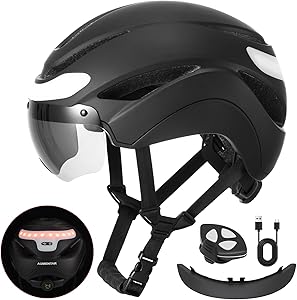
- Lighting System: Integrated front light + rear turn signals with wireless remote.
- Safety Certs: Dual CPSC & CE certified with PC+EPS structure.
- Fit: 360° dial adjustment system, fits 57-69cm (Large).
- Package: Includes visor, goggles, remote, charging cable, and bag.
The AUMENTAR Bike Helmet is the most technologically advanced model in this lineup, featuring a sophisticated lighting system that includes a front light and rear turn signals controlled by a wireless handlebar remote. This innovation significantly boosts communicative safety on the road, allowing you to signal intentions without taking your hands off the bars—a feature typically found on higher-end or motorcycle helmets.
It comes as a complete kit with virtually every accessory a rider could want, including both a visor and goggles. The large size range and dial adjustment promise a good fit for most adults. The trade-off for this tech and completeness is a higher weight (405g) and greater complexity. This helmet is ideal for commuters and e-bike riders who prioritize maximum visibility and vehicle-like signaling in urban traffic.
- Pros: Advanced wireless remote turn signal system; Complete all-in-one package
- Cons: Heaviest helmet listed (405g); Complex system has more parts to maintain/charge
7. Shinmax Bike Helmet

- Goggle Design: Detachable magnetic goggles with UV400 protection.
- Weight: Super lightweight at 310g (0.68 lb).
- Ventilation: Streamlined design with 7 breathable vents.
- Fit: Adjustable for 56-62cm head circumference with quick-release buckle.
The Shinmax Bike Helmet is a straightforward, value-oriented option that focuses on the core feature of magnetic goggles. The goggles offer UV400 protection and are held by three magnets, allowing them to be flipped up or down easily. The helmet emphasizes a lightweight and aerodynamic profile, with seven vents designed to reduce air resistance and sweating during rides.
It offers a simple adjustment system and a quick-release buckle for easy on/off. Notably, it lacks an integrated lighting system, which keeps the design simple and the cost down but reduces safety visibility in low light. This helmet is a good basic choice for casual riders, commuters, or skaters who specifically want the integrated goggle protection from sun and debris without extra bells and whistles, in a very light package.
- Pros: Lightweight and affordable; Simple, effective magnetic goggles
- Cons: No integrated safety lights; Minimal ventilation compared to others
How to Choose the Perfect Road Bike Helmet with a Visor
For decades, bicycle helmets followed a rigid style guide: road cyclists wore sleek, visor-less helmets designed for ventilation and aerodynamics, while mountain bikers and commuters opted for helmets with visors to block sun and debris. However, a significant evolution has occurred in road cycling. Road bike helmets with integrated visors—often inspired by time-trial shields or aero-helmets—have surged in popularity among everyday road riders, endurance cyclists, and triathletes. A visor on a road helmet offers aerodynamic advantages, eye protection from sun, rain, and debris, and a seamless solution for riders who wear prescription glasses.
Choosing the right road bike helmet with a visor requires balancing safety, aerodynamics, fit, and visor functionality. This comprehensive guide breaks down everything you need to know to make an informed decision.
Why Choose a Road Bike Helmet with a Visor?
Before diving into selection criteria, it is essential to understand the unique benefits this helmet style provides:
- Eye Protection: Integrated visors offer a wider, unobstructed field of view compared to standard sunglasses. They guard against wind, dust, insects, and rain, keeping your eyes from watering during high-speed descents.
- Aerodynamic Efficiency: Visors smoothly bridge the gap between the helmet shell and your face, reducing air turbulence and drag. This is why they are standard equipment in time trials and track cycling.
- Eyeglass Friendly (OTG): For cyclists who wear prescription glasses, finding sunglasses that fit or paying for expensive prescription sports lenses can be difficult. Many integrated visors leave enough clearance underneath to comfortably accommodate normal optical frames.
- Consistent UV Protection: Unlike sunglasses that can slip down your nose when you sweat, a helmet visor remains perfectly positioned throughout your entire ride.
Key Considerations When Choosing a Helmet
1. Visor Attachment Mechanisms
Not all visors attach to road helmets the same way. The attachment mechanism dictates how easy it is to remove, flip, or replace the visor mid-ride. There are two primary types:
- Magnetic Attachment: This is the most popular system for road cycling. Powerful rare-earth magnets hold the visor firmly against the helmet. If you want to remove it, you simply pull it off and flip it upside down onto the upper magnetic mounts on the helmet shell. This is highly recommended for its ease of use while riding.
- Fixed or Clip-On Mechanisms: These visors snap into dedicated slots or pivot points. They offer a very secure fit but are much harder to remove or adjust while actively riding. These are more common on commuter-crossover road helmets.
2. Lens Quality and Tint Options
The visor is essentially a giant pair of sunglasses, meaning lens quality is paramount. Look for lenses made from high-grade polycarbonate, which provides shatter resistance and sharp optical clarity without distortion.
Consider the lighting conditions of your typical rides. Ideally, choose a helmet system that allows you to swap lenses, or one that comes with multiple visor options:
- Mirrored/Dark Tints: Best for bright, sunny days, reducing glare and eye strain.
- Yellow/Amber Tints: Excellent for overcast days, low-light dawn/dusk conditions, or shaded forested roads, as they enhance contrast.
- Clear Lenses: Perfect for night riding or heavy rain where protection from elements is needed without light reduction.
- Photochromic Lenses: The premium choice. These lenses automatically darken in response to sunlight and clear up in shaded or dark environments, eliminating the need to swap visors.
3. Ventilation and Airflow
Road helmets are designed to keep your head cool during intense climbs. Adding a large visor can potentially block airflow to your forehead, leading to overheating or visor fogging. Look for helmets that feature air channels right above the visor attachment line. Advanced models incorporate anti-fog coatings on the inside of the visor and specialized vent ports that pull air behind the shield to keep your face cool and clear.
4. Safety Ratings and Technologies
While the visor adds convenience, the primary job of the helmet is protection. Ensure any helmet you consider meets localized safety standards (such as CPSC in the United States, CE EN1078 in Europe, or AS/NZS 2063 in Australia). Furthermore, look for rotational impact protection technologies, such as MIPS (Multi-directional Impact Protection System) or proprietary equivalents like KinetiCore or WaveCel. These systems reduce the rotational forces transmitted to the brain during an angled impact.
Comparing Visor Helmets to Traditional Setup
To help visualize how a visored road helmet stacks up against a traditional road helmet paired with cycling sunglasses, review the comparison below:
Prescription Frame CompatibilityHigh; easily fits over most optical glassesLow; requires contact lenses or prescription sunglasses
| Feature | Road Helmet with Integrated Visor | Traditional Road Helmet + Sunglasses |
|---|---|---|
| Field of Vision | Maximised, frameless, no peripheral obstruction | Can be restricted by sunglass frames |
| Aerodynamics | Superior; creates a unified aero profile | Standard; air can gap between face and glasses |
| Ventilation Consistency | Moderate; prone to fogging if poorly vented | High; individual glasses allow localized air movement |
| Weight Distribution | Centered on the head; slightly front-heavy | Distributed between ears, nose, and head |
Achieving the Perfect Fit
A helmet is only safe and comfortable if it fits correctly. When purchasing a visor helmet, keep these specific fitting steps in mind:
Measure Your Head Circumference
Use a flexible measuring tape wrapped around your head, about one inch above your eyebrows. Match this measurement against the manufacturer’s size chart. Do not assume your size is uniform across different brands.
Check the Dial-Fit System
Modern road helmets feature an adjustable retention cradle at the back. Put the helmet on, tighten the dial, and shake your head gently without the chin strap fastened. The helmet should stay securely in place without causing painful pressure points.
Test Visor Clearance
If you wear optical glasses, put them on before pulling the visor down. Ensure the visor does not press your glasses against the bridge of your nose. Even if you do not wear glasses, verify that the bottom edge of the visor does not touch your nose or cheeks, as constant rubbing will become agonizing over long distances.
Maintenance and Care Tips
To extend the life of your visored road bike helmet, proper maintenance is required:
- Avoid Harsh Chemicals: Clean the visor lens only with warm water and a mild soap, or specialized lens cleaner. Avoid window cleaners or alcohol, as they destroy anti-fog and UV-protective coatings.
- Use a Microfiber Bag: When storing or transporting the helmet, place the visor inside a soft microfiber pouch to prevent scratches from other gear.
- Inspect Magnetic Mounts: Regularly check that the magnets or clips are free of dirt, road grit, or metallic debris that could weaken the attachment strength.
Conclusion
Choosing a road bike helmet with a visor is an excellent upgrade for riders seeking optimized aerodynamics, superior weather protection, and an expansive field of view. By prioritizing a secure magnetic attachment system, high-optical lens clarity, rotational safety tech, and ample ventilation, you can elevate both your safety and performance on the open road. Ensure a perfect fit with your existing eyewear, and enjoy the streamlined freedom of a integrated shield system.