Best Budget Cycling Power Meters of 2026
Training on feel can be fun, but it’s not always accurate. That’s where cycling power meters step in. They give clear numbers that show how hard you are really working. With this data, you can train smarter, recover better, and push limits safely. The good news is that power meters no longer need a big budget. Affordable models are now available for everyday riders. In this article, we’ll look at the best budget cycling power meters that deliver real value on every ride.
1. Favero Assioma Uno Pedal

- Battery Life: Rechargeable lithium-ion battery providing 50 hours of use
- Connectivity: Dual Bluetooth and ANT+ communication for all devices
- Installation: Standard pedal installation requiring no special tools
- System Options: Available in single-sided (UNO) or dual-sided (DUO) versions
The Favero Assioma Uno Pedal is a standout choice for cyclists looking to enter the world of power measurement without a massive headache. Its primary appeal lies in its simplicity, as the unit installs just like a standard pedal, making it easy to swap between different bikes in your stable. By measuring power at the left pedal and doubling it, it provides highly reliable data that helps you optimize every stroke through smart, cutting-edge technology.
Durability is a major factor here, as the sensors are protected in a resin block that is both waterproof and shock-resistant. The inclusion of rechargeable batteries is a massive convenience, eliminating the need to constantly buy disposables. With seamless connectivity to both Android and iOS smartphones via ANT+ and Bluetooth, this power meter ensures that your training data is always accurate and ready for analysis on your favorite cycling apps.
Pros: Extremely easy installation, long-lasting rechargeable battery.
Cons: Single-sided measurement may be less precise for riders with significant leg imbalances.
See the Favero Assioma Uno Pedal
2. Sram Rival D1
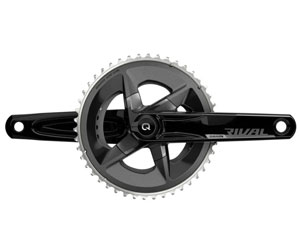
- Weight: Ultra-lightweight solution adding only 40g to a standard crankset
- Drivetrain: Designed specifically for 12-speed systems
- Platform: SRAM DUB Wide for maximum tire clearance on gravel bikes
- BCD: 94 Bolt Circle Diameter for specific chainring compatibility
The Sram Rival D1 power meter is an elegantly integrated solution designed specifically for the modern road and gravel enthusiast. Built upon the Quarq technology platform, this unit measures left-side power with high accuracy while maintaining a sleek, low-profile aesthetic. Its integration into the DUB Wide crankset ensures that riders can run the widest possible gravel tires without compromising the chainline or mechanical efficiency.
What makes this unit particularly attractive is its weight efficiency and reliability. Adding only 40 grams to the crankset, it offers a high-performance data solution without the bulk of traditional external sensors. The DUB bottom bracket platform simplifies the maintenance process and enhances the overall durability of the drivetrain. It is a rugged, reliable, and nearly invisible way to bring professional-grade power analytics to your everyday gravel or road adventures.
Pros: Very lightweight, excellent tire clearance for gravel, and a highly reliable bottom bracket design.
Cons: Limited to SRAM DUB Wide systems and does not include the bottom bracket.
3. Favero Assioma PRO RS-1
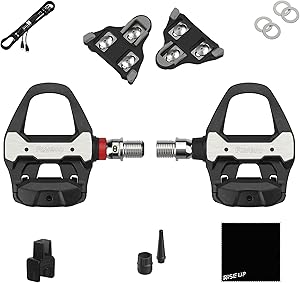
- Cleat Compatibility: Fully compatible with Shimano SPD-SL cleats (SM-SH10/11/12)
- Accuracy: IAV Power and integrated gyroscope provide ±1% accuracy
- Battery Life: Magnetic charging system providing 160 hours per charge
- Modular Design: Spindle allows for quick body swaps between road and MTB
The Favero Assioma PRO RS-1 represents a massive leap in modular power meter technology. This single-sided road pedal is 100% compatible with the Shimano SPD-SL system, allowing riders who prefer Shimano cleats to finally enjoy the benefits of Assioma sensors. The innovative design houses all electronics and batteries within the spindle, allowing users to swap the pedal body in seconds if they want to transition between road and mountain bike setups.
Beyond its versatility, the PRO RS-1 is engineered for extreme precision regardless of the environment. The Automatic Temperature Compensation ensures that your watt measurements remain stable between -10°C and 55°C. With a massive 160-hour battery life and a magnetic charging connector that prevents damage from accidental tugs, this is a sustainable and robust tool for serious athletes. It provides professional-level data with the convenience of simple, tool-free installation across multiple bikes.
Pros: Longest battery life in class, Shimano SPD-SL compatible, and impressive modular versatility.
Cons: Single-side sensing means total power is estimated by doubling the left leg output.
See the Favero Assioma PRO RS-1
4. Favero Assioma UNO
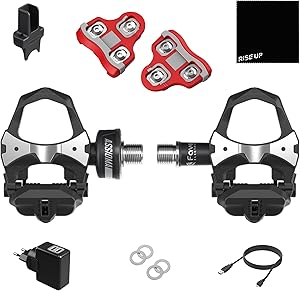
- Weight: Lightest and most compact pedal-based power meter available
- Weatherproofing: IP67 certified and protected by bi-component resin
- Temperature Range: Accurate measurements from -10°C to 60°C
- Charging: Dual-meter micro-USB cable with magnetic connectors
The Favero Assioma UNO is a revolutionary left-side power meter designed for road cyclists who value both data accuracy and ease of use. It stands out for its lightweight construction and compact profile, ensuring that the sensor never interferes with your pedaling, even during aggressive cornering. The inclusion of an IAV Power system and an integrated gyroscope allows the unit to detect instantaneous angular velocity, resulting in a ±1% degree of accuracy.
Installation is as straightforward as changing a standard pedal, making it a favorite for those who use multiple bikes. The resin-protected internals make the unit virtually indestructible against shocks and moisture, while the 50-hour rechargeable battery supports long training weeks. By pairing effortlessly with cycling computers and smartphones via Bluetooth and ANT+, the UNO provides a reliable and accessible pathway for any cyclist looking to refine their technique and monitor their physiological progress.
Pros: Easy to move between bikes, highly accurate gyroscope sensing, and superior waterproof protection.
Cons: Only measures power from the left pedal, which might miss right-leg specific imbalances.
5. GEOID PM500

- Material: 6061 aluminum alloy crank with CNC-machined 7075 spider
- Battery Life: 300 hours of use per charge with magnetic charging
- Metrics: Tracks power, cadence, L/R balance, and pedaling smoothness
- Compatibility: Standard 110BCD 4-bolt design for 12-speed systems
The GEOID PM500 is a comprehensive spider-based power meter kit that includes the Senicx PR3 crankset. This unit offers a sophisticated dual-sensor fusion algorithm that combines high-sensitivity strain gauges with an accelerometer for ±1.5% accuracy. It is particularly impressive for its data depth, providing riders with Power Quadrant Analysis and Left-Right Balance tracking. This allows for a scientific approach to training, helping you identify efficiency gaps and refine your pedaling technique in real-time.
With a massive 300-hour battery life, this power meter is built for endurance. The 680g aluminum structure provides a stiff and efficient platform for power transfer, and the IPX7 waterproof rating ensures it can handle the most punishing weather conditions. Whether you are using a Garmin, Wahoo, or smartphone, the dual Bluetooth and ANT+ connectivity makes syncing with platforms like Strava and Zwift incredibly easy. It is a professional-grade solution for riders who want deep analytical insights.
Pros: Incredible 300-hour battery life, provides left-right balance data, and features a stiff CNC spider.
Cons: Requires a full crankset installation compared to simpler pedal-based power meter options.
6. Favero Assioma PRO MX-2

- Sensing: Dual-sided measurement for independent left and right leg data
- Metrics: Measures balance, cadence, and overall pedal stroke dynamics
- Durability: Optimized for off-road performance without excess weight
- Connectivity: Seamless pairing with computers and training applications
The Favero Assioma PRO MX-2 is a premium dual-sided power meter designed for cyclists who demand the most detailed performance metrics. Unlike single-sided units, the MX-2 provides independent data for both the left and right legs, allowing for a precise analysis of power distribution. This level of detail is essential for identifying leg strength discrepancies and perfecting your pedal stroke dynamics, making it a favorite for competitive racers and data-driven training enthusiasts.
Built to withstand the rigors of cycling without adding unnecessary weight, the MX-2 ensures consistent and highly accurate power readings. The dual Bluetooth and ANT+ protocols mean you can easily link your pedals to a wide variety of bike computers and training apps. By capturing cadence and power balance alongside total wattage, the MX-2 offers a complete picture of your physiological output, helping you train more effectively and achieve your peak performance levels on every ride.
Pros: Precise independent left/right leg data, comprehensive pedaling analytics, and very easy to pair.
Cons: Higher price point due to the dual-sensing technology compared to single-sided models.
See the Favero Assioma PRO MX-2
7. Wearable4U Pedal Based Power Meter

- Power Sensing: True left-power data from the sensor in the left pedal
- Analytics: Tracks torque efficiency and pedaling smoothness
- Energy Efficiency: Automatic stand-by and instant wake-up functions
- Extras: Includes two pairs of cleats and a specialized cleaning cloth
The Wearable4U bundle featuring the Favero Assioma UNO is a comprehensive kit designed for riders who want everything they need in one package. This pedal-based system measures power at the point of application, providing highly accurate readings of your force. In addition to standard power and cadence, this unit offers deep pedaling analytics like torque efficiency and smoothness, giving you a professional-grade look at how your energy is actually being used on the road.
Maintenance and usability are simplified through the use of magnetic charging and an intelligent stand-by mode that preserves the 50-hour battery life. The pedals are incredibly fast to move between different bikes, requiring no specialized mechanical skills. With the added value of extra cleats and cleaning accessories, this package ensures that your power meter remains in top condition. It is an excellent entry point for any cyclist looking to bring data-driven discipline to their daily training sessions.
Pros: Includes extra accessories, features power-saving auto-standby, and offers deep pedaling analytics.
Cons: Only includes the left sensor, meaning total power values are calculated by doubling.
See the Wearable4U Pedal Based Power Meter
8. Garmin Rally RS100
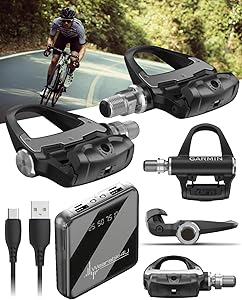
- Compatibility: Designed for use with Shimano SPD-SL cleats
- Versatility: Transferable spindle compatible with RK and XC pedal bodies
- Upgradability: Can be upgraded to a dual-sensing system later
- Integration: Seamless syncing with Garmin Edge computers and Garmin Connect
The Garmin Rally RS100 is a high-performance, single-sensing power meter that offers unparalleled flexibility for multi-discipline cyclists. By measuring power at the left pedal, it provides essential cadence and total power data with impressive accuracy. One of its standout features is the transferable spindle, which allows you to swap the internal power sensor into different pedal bodies for road, gravel, or cyclocross use, ensuring you have power data all year round.
Designed for those who already use the Shimano SPD-SL system, these pedals offer a familiar and secure engagement for road cycling. The integration with the Garmin ecosystem is flawless, making software updates and data uploads through the Garmin Connect app a breeze. If you eventually decide you need more data, the RS100 is fully upgradable to a dual-sensing system, making it a future-proof investment that grows with your cycling ambitions and technical requirements.
Pros: Spindle can be used in MTB or road bodies, easy to upgrade later, and great Garmin integration.
Cons: Initial purchase only provides single-side sensing and relies on non-integrated batteries.
How to Choose Budget Cycling Power Meters
Cycling has evolved from being a simple outdoor activity to a performance-driven sport where athletes and enthusiasts alike rely on advanced tools to measure their progress. Among these tools, the power meter has become one of the most valuable pieces of equipment for serious cyclists. Traditionally, power meters were considered premium devices with hefty price tags. However, as technology advances and competition grows, affordable options have emerged, making them more accessible than ever.
If you’re looking to improve your training while sticking to a budget, understanding how to choose the best budget cycling power meters is crucial. This guide will walk you through what power meters are, why they matter, and the key factors to consider before investing in one.
What is a Cycling Power Meter?
A power meter is a device that measures the actual output of your pedaling in watts. Unlike heart rate monitors, which reflect your body’s physiological response, a power meter gives you direct, real-time data on how much energy you are putting into the pedals.
By knowing your power output, you can structure workouts with precision, monitor progress, and train smarter rather than harder. For cyclists on a budget, entry-level power meters are a game changer, offering access to data that was once reserved for elite professionals.
Why Choose a Budget Power Meter?
Budget-friendly power meters allow you to gain performance insights without burning a hole in your pocket. Here’s why they’re a worthy investment:
-
Affordable Training Tool: You can now find reliable power meters for under $400, sometimes even below $200, compared to premium models that cost upwards of $1,000.
-
Accurate Data: Even budget power meters provide consistent readings, helping you track training progress effectively.
-
Training Efficiency: By understanding your power zones, you can train more efficiently and avoid overtraining or undertraining.
-
Long-Term Value: Unlike bike upgrades (wheels, frames), power data directly improves your fitness and performance.
Types of Cycling Power Meters
Before choosing the best budget option, it’s important to understand the different types available:
-
Crank-Based Power Meters
-
Installed on the crank arm or crankset.
-
Offer good accuracy but can be more expensive.
-
Budget-friendly single-sided crank-based options exist.
-
-
Pedal-Based Power Meters
-
Built directly into the pedals.
-
Easy to install and switch between bikes.
-
Single-sided models are more affordable, while dual-sided are pricier.
-
-
Hub-Based Power Meters
-
Integrated into the rear wheel hub.
-
Durable and accurate, but less common nowadays.
-
-
Spider-Based Power Meters
-
Positioned in the spider of the crankset.
-
Typically more expensive but highly accurate.
-
For budget-conscious cyclists, single-sided crank arm or pedal-based power meters are usually the best entry point.
Key Factors to Consider When Choosing a Budget Power Meter
1. Price and Value
The biggest factor in choosing a budget power meter is finding the balance between affordability and reliability. Don’t simply go for the cheapest model—make sure it comes from a reputable brand known for consistency.
2. Accuracy
Most modern power meters, even budget models, offer accuracy within ±2% to ±3%. This level of precision is good enough for most cyclists. Avoid going for unreliable no-name brands that may give inconsistent data.
3. Single-Sided vs. Dual-Sided
-
Single-Sided Power Meters: Measure power from one leg (usually the left) and double it. These are more affordable but less precise if you have leg imbalances.
-
Dual-Sided Power Meters: Measure both legs independently, offering more accuracy but at a higher cost.
If you’re on a tight budget, single-sided models are still a fantastic entry point.
4. Compatibility
Check whether the power meter fits your bike’s crankset, pedals, or bottom bracket. Pedal-based meters are generally universal, while crank-based options may require a specific crankset model.
5. Ease of Installation
If you own multiple bikes, a pedal-based power meter may be more convenient as it can be easily swapped between bikes. Crank-arm meters require more effort to switch.
6. Battery Life
Budget power meters may use either rechargeable batteries or replaceable coin-cell batteries. Look for a model with decent battery life (100–200 hours) to minimize frequent replacements.
7. Connectivity (ANT+ & Bluetooth)
Ensure your power meter supports ANT+ and Bluetooth Smart, allowing it to connect to your cycling computer, smartphone apps, or smart trainer. Most modern budget models support both.
8. Durability and Weather Resistance
Since cycling often happens in unpredictable weather, your power meter should be waterproof and built to withstand rain, dirt, and sweat.
9. Weight
Though not a major factor for budget-conscious riders, weight may matter for competitive cyclists. Pedal-based meters tend to be slightly heavier than standard pedals, while crank-based models are relatively lightweight.
10. Brand Reputation and Support
Stick with well-known brands such as 4iiii, Stages, Garmin, Favero, and SRAM. These brands have proven track records, customer support, and firmware updates to ensure long-term reliability.
Best Budget Power Meter Options
While availability may vary by region, here are some widely recommended budget-friendly choices:
-
4iiii Precision 3 (Single-Sided Crank Arm)
-
Price: Around $300
-
Lightweight, reliable, and accurate.
-
-
Stages Power L (Single-Sided Crank Arm)
-
Price: Around $325
-
Trusted by professionals, simple design.
-
-
Garmin Rally RS100 / RK100 (Single-Sided Pedal)
-
Price: Around $350–$400
-
Easy installation, compatible with most bikes.
-
-
Favero Assioma UNO (Single-Sided Pedal)
-
Price: Around $400
-
Excellent accuracy, rechargeable battery.
-
-
SRAM Rival AXS Crankset (Power Meter Upgrade Kit)
-
Price: Around $350
-
Great option for riders with SRAM groupsets.
-
Tips for Getting the Most Out of a Budget Power Meter
-
Pair It with Training Apps: Use platforms like Zwift, TrainerRoad, or Strava to analyze and improve your performance.
-
Learn Your Power Zones: Understanding Functional Threshold Power (FTP) and training zones helps maximize workouts.
-
Maintain Regular Calibration: Most meters require zero-offset calibration before rides for accurate data.
-
Monitor Battery Levels: Keep spare batteries or charging cables handy to avoid mid-ride shutdowns.
-
Don’t Obsess Over Numbers: Power data is valuable, but it’s just one tool. Combine it with perceived effort and heart rate for a complete picture.
Final Thoughts
Choosing the best budget cycling power meter doesn’t mean compromising on quality or performance. By understanding your needs, the different types of power meters, and key buying factors like accuracy, compatibility, and durability, you can find an option that fits both your training goals and budget.
For most riders, a single-sided crank arm or pedal-based power meter from a reputable brand offers the perfect entry point into power-based training. With this tool, you’ll gain precise insights into your performance, train more effectively, and ultimately become a stronger cyclist—without draining your wallet.