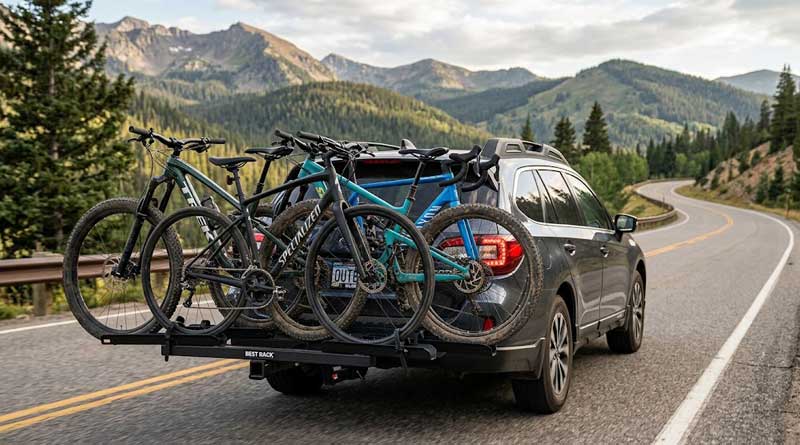
Best Hitch Bike Racks for 4 Bikes of 2026
Looking to haul four bikes at once? You need a hitch rack that’s tough, secure, and easy to use. Whether you’re heading out with the whole family or a group of friends, the right rack saves you hassle and protects your gear. In this article, we break down the best hitch bike racks for four bikes—simple choices built to last.
1. Thule Apex XT 4

- Bike Capacity: 4-bike capacity
- Max Bike Weight: 37.5 lbs. per bike
- Hitch Receiver: Fits 1.25 or 2 inches
- Trunk Access: Unloaded tilt access
The Thule Apex XT 4 is a premium hitch-mounted rack designed with family adventures in mind. It stands out by offering a generous seven inches of spacing between each bike, which significantly reduces the risk of contact and scratches during transit. The inclusion of an integrated cable lock adds a layer of security, letting you step away from your vehicle with peace of mind.
This hanging-style rack attaches directly to the bike frame, making it highly compatible with fat-tire models and bikes with fenders. While it requires you to unload the bicycles to gain full trunk access, the overall build quality and robust protection features make it a reliable choice for frequent travelers.
Pros:
- Generous 7-inch bike spacing
- Integrated security cable lock
- Fits multiple hitch receiver sizes
Cons:
- No trunk access when fully loaded
- Frame mounting may require adapters for unique frames
2. Allen Sports Deluxe 4

- Hitch Receiver: Fits 2-inch hitches only
- Tie-Down System: Patented individual cradles
- Trunk Access: Tilts back for lift-gate access
- Finish: Black powder-coated steel
The Allen Sports Deluxe 4 offers an efficient and straightforward method for transporting up to four bicycles. Its standout feature is the patented tie-down cradle system, which individually isolates and protects each bicycle from moving around. Security and stability are further enhanced by a specialized no-wobble bolt that eliminates excess play inside the receiver hitch during transit.
Convenience is central to this model, as the carry arms easily fold out of the way when the rack is not in use. This makes parking and garage storage much easier. Additionally, all vital retainer clips are tethered with lanyards to prevent lost parts during setup, though minor assembly is required before your first trip.
Pros:
- Folding carry arms save space
- No-wobble bolt improves stability
- Lanyards prevent losing critical pins
Cons:
- Only fits larger 2-inch hitches
- Requires initial assembly out of the box
3. MaxxHaul Hitch Mount Bike Rack

- Total Weight Capacity: 150 lbs. total
- Hitch Receiver: Fits 2 x 2 inch receivers
- Frame Requirements: Horizontal top bar frame
- Material: Rigid powder-coated steel
The MaxxHaul Hitch Mount Bike Rack is a durable, all-steel transportation solution engineered for longevity and safety. It features a helpful swing-down mechanism that grants users effortless access to the rear lift-gate without completely removing the setup. This design makes it well-suited for a variety of larger vehicles, including SUVs, vans, and pickup trucks.
Bikes are held firmly in place using adjustable cradles paired with hook-and-loop straps along the support arms. For added safety on the road, the rack includes a built-in reflector and a standard hitch pin. Note that non-traditional bike frames will require a separate crossbar adapter for proper mounting on this system.
Pros:
- Swing-down feature allows quick rear vehicle access
- Heavy-duty all-steel construction
- Included safety reflector increases visibility
Cons:
- Requires horizontal top bar frames or adapters
- Straps can wear down faster than hard plastics
See the MaxxHaul Hitch Mount Bike Rack
4. Yakima RidgeBack

- Max Bike Weight: 40 lbs. per bike
- Hitch Receiver: Fits 1.25 or 2 inches
- Assembly: Comes fully assembled
- Product Weight: 35 lbs. total weight
The Yakima RidgeBack user-friendly hitch rack arrives fully assembled right out of the box, removing any frustrating setup headaches. Designed to carry up to four bikes, it utilizes a hanging frame attachment system that keeps your load stable. It accommodates a wide variety of bicycle styles, including options with fenders and larger fat-tire configurations.
A key highlight of this model is its user-friendly tilt-down feature, which simplifies cargo management by allowing clear entry to the back of your vehicle. While it is best to tilt the rack while it remains unloaded, the overall lightweight 35-pound structure ensures that handling, installation, and removal remain stress-free tasks.
Pros:
- Ready to use with zero assembly required
- Compatible with fat-tire and fendered bikes
- Dual-fit shank for small and large hitches
Cons:
- Must be unloaded to tilt safely
- Lacks a built-in lock system out of the box
5. Thule ReVert

- Max Bike Weight: 55 lbs. per bike
- Bike Attachment: Wheel contact point
- Trunk Access: Loaded tilt mechanism
- RV Compatibility: Certified for RV use
The Thule ReVert provides an innovative vertical hanging solution tailored for heavy-duty hauling, including electric bikes up to 55 pounds each. By orienting the fleet vertically, this rack maximizes space and minimizes any potential bike-to-bike contact. Because it secures the bikes via the wheels rather than the frame, it is excellent for preserving high-end paint jobs.
This model is fully RV compatible, meaning it can withstand the unique vibrations of towed vehicles. It features a loaded tilt mechanism, allowing you to lower the assembly for trunk access even when full. However, its robust 72-pound weight makes installation a two-person job.
Pros:
- High weight capacity supports heavy e-bikes
- Tilts away even when fully loaded
- Wheel attachment eliminates frame scratches
Cons:
- Very heavy unit at over 72 pounds
- Expensive relative to standard hanging options
6. Thule Apex XT Swing

- Trunk Access: Side swing design
- Max Bike Weight: 35 lbs. per bike
- Integrated Lock: Yes, included
- Hitch Receiver: Fits 2-inch hitches
The Thule Apex XT Swing is a high-end carrier that prioritizes both vehicle access and bike protection. Equipped with specialized anti-sway cradles and a seven-inch gap between bikes, it keeps your gear stable and scrape-free. Security is integrated seamlessly through a built-in lock system, making it a self-contained solution for road trippers.
Its premier characteristic is the side-swing functionality. This engineering choice allows the entire loaded rack to swing completely clear of the rear door, granting unhindered access to your trunk. Keep in mind that this advanced swing mechanism adds some extra weight, bringing the unit up to 42 pounds.
Pros:
- Swing-away arm gives full trunk access while loaded
- Anti-sway cradles prevent bike contact
- Includes built-in lock system
Cons:
- Heavier than standard non-swing models
- Strictly limited to 2-inch receiver hitches
7. Amazon Basics 4-Bike Hitch Rack

- Total Weight Capacity: 132 lbs. total capacity
- Hitch Receiver: Fits 2-inch hitches
- Material: Powder-coated steel frame
- Storage: Foldable design for storage
The Amazon Basics 4-Bike Hitch Rack is an accessible and practical choice for family vacations, group rides, and camping trips. Built with a durable powder-coated steel frame, it incorporates reinforced tie-down points to keep up to four bikes secured. An anti-rattle mechanism is also integrated to reduce noise and wobbling while driving.
This rack features a foldable design, making it simple to store in your garage or trunk when it is detached. Users must be aware that this unit cannot clear rear-mounted spare tires. It may also block or interfere with backup sensors or cameras on certain larger pickup truck models.
Pros:
- Budget-friendly option for casual users
- Anti-rattle system minimizes noise
- Folds down compactly for storage
Cons:
- Not compatible with rear spare tires
- Can interfere with backup cameras and sensors
See the Amazon Basics 4-Bike Hitch Rack
8. Yakima FullSwing

- Trunk Access: Side swing-away pivot
- Max Bike Weight: 40 lbs. per bike
- Hitch Receiver: Fits 2-inch hitches
- Product Weight: 56 lbs. total weight
The Yakima FullSwing represents a top-tier option for cyclists who demand uncompromised access to the back of their vehicle. Its defining characteristic is the side-swing pivot mechanism, which effortlessly swings a fully loaded rack out of the way. This ensures you can open your tailgate or hatch instantly without unloading your bikes first.
Safety and protection are fully addressed with integrated locks that secure your investment directly to the carrier frame. It handles fendered bicycles well, utilizing a stable hanging mount setup. Because of the heavy swing-away hardware, the rack weighs a substantial 56 pounds, requiring extra effort during initial installation.
Pros:
- Pivots away smoothly even when fully loaded
- Integrated security locks included
- Compatible with bikes featuring fenders
Cons:
- Heavy 56-pound frame is cumbersome to carry
- Higher price point due to swing mechanism
How to Choose Hitch Bike Racks for 4 Bikes
Transporting a group or a family of cyclists requires a reliable, sturdy, and efficient transportation system. When you need to carry four bicycles simultaneously, standard roof racks or trunk mounts often fall short due to weight limits and clearance issues. That is where a 4-bike hitch rack becomes an invaluable asset. Choosing the right hitch rack involves understanding your vehicle’s capabilities, your bicycle types, and how you intend to access your cargo during trips. This guide breaks down the essential factors to consider so you can make an informed investment.
Understanding Hitch Receiver Sizes and Weight Capacities
Before looking at bike racks, you must inspect the hitch receiver installed on your vehicle. Hitch receivers generally come in two standard opening sizes for passenger vehicles: 1.25 inches and 2 inches. This distinction is critical because most 4-bike racks require a 2-inch receiver due to the leverage and weight of carrying four bicycles.
Hitch Classes and Towing Specs
Hitches are rated by classes ranging from Class I to Class V. A Class I or Class II hitch typically features a 1.25-inch receiver and is restricted to lower tongue weights. Class III hitches and above feature a 2-inch receiver. Because four bikes plus the weight of the rack itself can easily exceed 150 to 200 pounds, you must verify your hitch’s maximum tongue weight rating. Never exceed the tongue weight capacity specified by your vehicle or hitch manufacturer, as doing so can compromise your vehicle’s handling and structural integrity.
Hanging vs. Platform vs. Vertical Styles
Hitch-mounted racks for four bikes generally fall into three design categories: hanging racks, platform racks, and vertical racks. Each style handles bicycles differently and changes how the load sits behind your vehicle.
Hanging Hitch Racks
Hanging racks are the most traditional and budget-friendly option for carrying multiple bikes. On these models, bicycles hang by their top tubes from dual support arms and are secured with rubber or plastic straps. Hanging racks are lightweight, compact, and easy to store when detached from the car. However, because the bikes hang freely, they can sway and contact one another during transit unless the rack includes specialized anti-sway cradles. Additionally, bikes with non-traditional frames—such as step-through frames, full-suspension mountain bikes, or kids’ bikes—often require an aftermarket frame adapter bar to sit level on the arms.
Platform Hitch Racks
Platform racks hold bicycles by their wheels on individual trays or trays with ratcheting arms. This design keeps the bikes incredibly stable and eliminates bike-to-bike contact entirely, making it the safest option for expensive carbon frames or custom paint jobs. Loading bikes onto a platform is much easier because you only need to lift them a few inches into a tray rather than threading them onto hanging bars. The downside is that 4-bike platform racks are exceptionally heavy, bulky, and stick out significantly far behind the vehicle, which can make parking difficult.
Vertical Hitch Racks
Vertical racks are a popular choice for large families, mountain bikers, and van owners. These racks hold bicycles vertically by the handlebars or front wheels, lining them up side-by-side like a rolling fence. This configuration keeps the bikes tightly clustered together, minimizing how far the rack extends past your rear bumper. Vertical racks generally boast very high weight capacities, making them capable of handling heavy mountain bikes or electric bikes. They are highly specialized and tend to be more expensive, but they offer unparalleled stability for maximum capacity loads.
Rear Vehicle Access and Movement Mechanisms
When your hitch rack is loaded with four bicycles, it completely blocks your trunk, tailgate, or hatch. Manufacturers use three primary engineering methods to allow you to get into your cargo area without removing the entire assembly.
Tilt-Down Racks
Tilt-down racks feature a release pin or lever near the base that allows the main mast or platform to tilt downward away from the vehicle. Basic hanging racks typically can only tilt when they are completely unloaded. Premium platform or hanging models are engineered with robust pivot points that allow them to tilt even when fully loaded with four bikes. While convenient, tilting a fully loaded rack requires significant physical strength to lower and lift safely.
Swing-Away Racks
Swing-away racks offer the ultimate convenience for SUVs, trucks, and vans. Utilizing a heavy-duty side-hinge design, the entire rack pivots 90 degrees to the side of the vehicle, opening up completely unobstructed access to the rear doors. You do not have to lift or lower any heavy weight; the rack simply swings open like a gate. This feature adds complexity, cost, and weight to the rack, but it is an invaluable luxury for camping trips and long road travel where rear access is needed frequently.
Bike Compatibility Considerations
Not every bike rack can carry every type of bicycle. You must audit your fleet of bicycles before choosing a specific model.
Bikes with Fenders and Fat Tires
If your family rides fat-tire bikes, you need a rack with extra-wide wheel trays and longer straps to accommodate tires wider than three inches. Conversely, if your bikes have full-coverage fenders, you must avoid platform racks that secure the bike using a ratcheting hook over the front wheel, as the hook will crush the plastic or metal fender. Instead, look for frame-mounted hanging racks or platform styles that clamp onto the frame or use touchless tire baskets.
Electric Bikes (E-Bikes)
Electric bicycles are significantly heavier than traditional bikes, often weighing between 50 and 75 pounds each due to their motors and batteries. Standard hanging or light platform racks have per-bike weight limits of 35 to 40 pounds. If you plan to transport electric bikes, you must buy a heavy-duty platform or vertical rack rated explicitly for e-bike weights, and it is highly recommended to remove the bike batteries during transit to save weight.
Security, Anti-Rattle, and Safety Features
A 4-bike rack carries thousands of dollars of equipment, making security and stability major priorities. Look for racks that feature integrated locking systems. This includes a hitch lock that locks the rack to your vehicle receiver, alongside integrated cable locks or locking arms that secure the individual bicycles to the frame of the rack itself.
To prevent the rack from swaying and making noise while driving, high-quality models utilize anti-rattle hitch pins or expanding wedge mechanisms inside the receiver tube. This tightens the connection, turning the rack and the car frame into a single solid unit. Finally, because a 4-bike setup can obscure your vehicle’s tail lights and license plate, check if the rack includes built-in reflectors or supports optional light kits to maintain legal visibility on the highway.
Conclusion
Choosing the best 4-bike hitch rack requires balancing budget, bike styles, and convenience. If you want an affordable, lightweight option for standard road or hybrid frames, a hanging rack is an excellent choice. If you own expensive carbon frames, heavy e-bikes, or bikes with unique geometries, investing in a robust platform or vertical rack is necessary. Factor in how often you will need trunk access, check your vehicle’s hitch class weight limit, and select a system that keeps your gear secure and your travels stress-free.