Best Mini Pumps for Mountain Bikes of 2026
If you ride mountain bikes, a flat tire is nearly guaranteed. Fixing it on the trail means you need a reliable mini pump. The best models are small enough to stash in a pack or pocket but powerful enough to get you rolling again fast. This guide breaks down the toughest, easiest-to-use mini pumps for mountain biking, helping you choose the right one without the hassle.
1. Topeak Peakini II

- Valve Compatibility: Presta and Schrader
- Max Pressure: 90 PSI
- Dimensions: 10.8 x 2 x 1.3 inches
- Weight: 4.6 ounces
The Topeak Peakini II is a compact and reliable mini pump built for cyclists who need a dependable emergency inflator on the go. Its efficient single-stroke pumping action means less effort per pump, and the T-handle design offers a comfortable, secure grip that makes the inflation process noticeably smoother than most competitors at this size.
Capable of reaching up to 90 PSI, it handles road bike tires with ease. The dual valve compatibility adds versatility, making it useful across different bike types. It’s a well-engineered, no-fuss pump that earns its place in any cycling kit.
- Pros: Comfortable T-handle grip, dual valve support, efficient single-stroke action
- Cons: 90 PSI ceiling may fall short for high-pressure road tires, no gauge included
2. BV Mini Bike Pump

- Valve Compatibility: Presta and Schrader (smart valve)
- Max Pressure: 120 PSI
- Mounting: Bracket included
- Extra Accessories: Sport ball needle included
The BV Mini Bike Pump punches above its weight class with a 120 PSI maximum pressure rating and a smart valve design that automatically accommodates both Presta and Schrader valves without any adapter swapping. The included mounting bracket keeps the pump securely attached to your frame during rides, so you won’t have to dig through your bag when a flat strikes.
Its versatility extends beyond cycling — the included ball needle lets you inflate footballs, pool floats, and inflatables. Lightweight construction makes it easy to carry anywhere. BV backs the pump with responsive customer support, adding peace of mind to an already well-rounded, budget-friendly package.
- Pros: High 120 PSI capacity, smart dual valve, mounting bracket included, multi-use needle
- Cons: Build quality may not match premium brands, no pressure gauge
3. Pro Bike Tool Mini Bike Pump

- Valve Compatibility: Presta and Schrader
- Max Pressure: 100 PSI / 6.9 Bar
- Inflation Speed: 30% faster than standard models
- Storage: Frame mount included
The Pro Bike Tool Mini Bike Pump stands out for its claimed 30% faster inflation compared to standard mini pumps, making it a smart pick for riders who want to get back on the road quickly after a flat. Its 100 PSI ceiling comfortably covers road, mountain, and BMX bikes, and the compact profile fits neatly into a jersey pocket or saddle bag.
Dual valve compatibility and a durable build make this pump a versatile, long-lasting addition to any kit. The included frame mount ensures it’s always within reach. For commuters, racers, and trail riders alike, it’s a reliable and efficient choice that delivers strong performance without bulk.
- Pros: Fast inflation, 100 PSI capable, compact design, durable materials
- Cons: No pressure gauge, speed claims may vary in real-world use
See the Pro Bike Tool Mini Bike Pump
4. West Biking Bicycle Pump
- Valve Compatibility: Presta and Schrader
- Max Pressure: 80–100 PSI
- Dimensions: 22.5 x 4.3 cm
- Weight: 139g
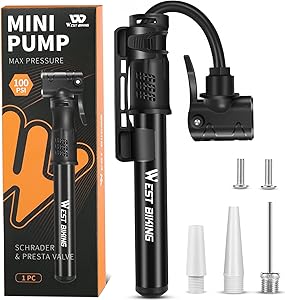
The West Biking Bicycle Pump features a hidden TPU flexible hose that extends or retracts via a locking mechanism, giving you adjustable reach and more comfortable pumping angles. The dual valve design supports both Presta and Schrader without adapter changes, and the high-strength locking buckle ensures a secure, leak-free connection every time you inflate.
Weighing just 139g and measuring under 23cm, it’s genuinely portable and can be mounted to your frame or tucked into a bag with ease. The included needle expands its use to footballs, swimming rings, and balloons. It’s a practical, well-rounded mini pump for everyday riders looking for versatility and convenience.
- Pros: Flexible extendable hose, dual valve, lightweight, multi-use needle
- Cons: Hose mechanism may wear over time, no pressure gauge
See the West Biking Bicycle Pump
5. Silca Tattico

- Valve Compatibility: Presta and Schrader
- Max Pressure: 100 PSI
- Dimensions: 9.5 x 1 inches
- Weight: 5.5 ounces
The Silca Tattico is a premium mini pump built for cyclists who refuse to compromise on quality during roadside repairs. Its inverted design paired with high-quality seals delivers exceptional pumping efficiency, meaning fewer strokes to reach your target pressure. At 100 PSI maximum, it handles road bike tires confidently and with noticeably less effort than budget alternatives.
Compact at 9.5 inches and weighing 5.5 ounces, it’s portable without sacrificing performance. Silca’s reputation for precision engineering shines through in the Tattico’s feel and durability. It’s an investment-grade tool for serious cyclists who want dependability when it matters most — stranded on the road with a flat tire.
- Pros: Highly efficient inverted design, premium build quality, 100 PSI capable, dual valve
- Cons: Premium price point, heavier than some competitors
6. Topeak Mountain TT G

- Valve Compatibility: Presta and Schrader
- Max Pressure: 60 PSI
- Integrated Gauge: Yes
- Weight: 227 grams
The Topeak Mountain TT G is purpose-built for mountain bikers, featuring TwinTurbo technology that uses both the push and pull strokes to move air more efficiently. This dual-action design significantly reduces the effort and time needed to fill larger-volume MTB tires. The integrated pressure gauge is a genuine standout feature at this size, letting you hit your target PSI with accuracy.
While the 60 PSI ceiling won’t satisfy road bike users, it’s perfectly suited for tubeless and high-volume MTB setups. Dual valve compatibility adds flexibility across bike types. At 227 grams it’s on the heavier side, but the TwinTurbo action and built-in gauge make that trade-off worthwhile for off-road riders.
- Pros: TwinTurbo dual-action pumping, integrated gauge, dual valve, efficient for large-volume tires
- Cons: 60 PSI limit unsuitable for road bikes, heavier than other mini pumps
7. GIYO Mini Bike Pump

- Valve Compatibility: Presta only
- Construction: All-metal CNC machined body
- Barrel Design: Telescopic high-pressure chambers
- Origin: Manufactured in Taiwan
The GIYO Mini Bike Pump is a road-specific tool built exclusively for Presta valves, making it a dedicated companion for road cyclists who demand optimal performance. Its all-metal CNC construction with a hammered finish gives it a premium look and feel, while the telescopic barrel with specially designed high-pressure chambers enables efficient inflation of higher-pressure road tires.
The metal valve lock lever provides a secure, leak-free connection with minimal fuss — simply press and lock. Its Taiwan-crafted build exudes quality and durability. If you ride exclusively road bikes with Presta valves and want a pump that reflects that focus with purpose-built engineering, the GIYO delivers exactly that without compromise.
- Pros: All-metal premium build, secure lock lever, optimized for high-pressure road tires, sleek design
- Cons: Presta-only limits versatility, not suitable for mountain bikes or Schrader valves
8. Fanttik X10 Ace

- Valve Compatibility: Presta and Schrader
- Max Pressure: 120 PSI
- Inflation Speed: 0–100 PSI in 80 seconds (700x23c)
- Accuracy: ±1 PSI precision with auto-stop
The Fanttik X10 Ace is a battery-powered electric mini pump that redefines convenience for modern cyclists. It inflates a 700x23c road tire from flat to 100 PSI in just 80 seconds, with a high-precision sensor and Fanttik Precision Compensation Technology ensuring accuracy within ±1 PSI. The LED screen displays real-time pressure, and the auto-stop function prevents over-inflation entirely.
Weighing only 0.26 lbs, it fits in jersey pockets and saddle bags effortlessly. The gear-fan integrated design manages heat effectively during use. Preset pressure memory and automatic pause make it exceptionally user-friendly. For cyclists who want fast, accurate, and effortless inflation without manual pumping, the X10 Ace is a genuine leap forward.
- Pros: Electric auto-inflation, ±1 PSI precision, LED display, auto-stop, extremely fast
- Cons: Requires charging, higher price point, overheat protection may interrupt longer sessions
9. Tiakia Mini Bike Pump

- Valve Compatibility: Presta, Schrader, and Dunlop
- Max Pressure: 260 PSI
- Air Volume: ~44 ml per stroke
- Weight: 5.3 ounces / 7.8 inches long
The Tiakia Mini Bike Pump makes a bold claim: a separate hose design that achieves both high air volume per stroke and extreme pressure capacity up to 260 PSI, reducing total pumping time by up to 50% compared to standard mini pumps. This balance is rare in compact pumps and makes it genuinely well-suited for road, e-bike, and even motorcycle tires.
Triple valve compatibility covering Presta, Schrader, and Dunlop gives it broader usefulness than most rivals. The aluminum alloy body with anodized finish offers strong corrosion resistance, and IPX4 waterproofing means it handles wet rides without issue. For cyclists wanting serious capacity in a small, durable package, the Tiakia is a compelling option.
- Pros: Exceptional 260 PSI capacity, triple valve support, high volume per stroke, waterproof build
- Cons: Heavier feel for a mini pump, separate hose adds setup time roadside
10. Vibrelli Mini Bike Pump

- Valve Compatibility: Presta and Schrader (auto-locking)
- Max Pressure: 120 PSI
- Design: Extendable telescopic barrel
- Warranty: 5-year manufacturer guarantee
The Vibrelli Mini Bike Pump earns attention with its clever auto-locking “Super-Fit” valve that secures onto both Presta and Schrader valves without adapters or manual adjustments — a genuine time-saver when you’re fixing a flat in poor conditions. The telescopic barrel switches between high-volume and high-pressure modes, giving it versatility across road and mountain bike tires up to 120 PSI.
The secure mounting bracket uses bottle cage bolts and a Velcro strap to keep the pump rattle-free on the frame. A glueless puncture kit is included, adding real roadside value. Backed by a five-year warranty, the Vibrelli is built with confidence and is an excellent all-rounder for cyclists who want reliability without complication.
- Pros: Auto-locking dual valve, telescopic design, puncture kit included, 5-year warranty
- Cons: No pressure gauge, not suitable for suspension inflation
See the Vibrelli Mini Bike Pump
The Ultimate Guide to Choosing the Best Mini Pump for Your Mountain Bike
For mountain bikers, punctures and tire pressure adjustments are an inevitable part of the trail experience. Whether you push your limits on sharp rock gardens, weave through thorny singletracks, or run tubeless setups that occasionally suffer from a burp, a reliable inflation method is a mandatory piece of gear. While floor pumps are the standard for pre-ride maintenance in the garage, a mini pump is your mechanical insurance policy out on the trail. Choosing the right mini pump for a mountain bike, however, requires a different set of priorities compared to choosing one for a road or gravel bike. This guide explores the mechanical nuances, volume dynamics, and structural features you must evaluate to find the perfect trailside companion.
High Volume Versus High Pressure
The single most critical mistake riders make when purchasing a mini pump is failing to match the pump’s internal chamber design with their tire type. Pumps are generally engineered into two categories: High Pressure (HP) and High Volume (HV).
Understanding High Volume (HV) Dynamics
Mountain bike tires are characterized by their large physical size and relatively low operating pressures, typically ranging from 18 to 35 PSI (pounds per square inch). To fill these wide, high-air-capacity tires efficiently, you need a High Volume pump. HV mini pumps are designed with wider internal barrels. This structural width allows the pump to push a significantly higher amount of air into the tire with every single stroke. If you use an HV pump on a mountain bike tire, you will drastically minimize the number of strokes required to get back to riding pressure, saving your arms from severe fatigue. However, because of the wider barrel, pushing air becomes progressively harder as the pressure increases, which is why these pumps usually max out around 50 to 60 PSI—more than enough for any mountain bike application.
Why High Pressure (HP) Pumps Fail on Trails
Conversely, High Pressure pumps are built for skinny road tires that require 80 to 120 PSI. HP pumps utilize very narrow barrels to make it physically easier to push air against high resistance. If you attempt to use an HP pump on a 29-inch by 2.4-inch mountain bike tire, the volume of air transferred per stroke will be miniscule. You could easily find yourself pumping thousands of times, spending half an hour on the side of the trail just to reach a ridable pressure. Always verify that the mini pump you are looking at is explicitly designated as an HV (High Volume) model.
Hose Versus Direct-Head Connections
Once you narrow your selection down to high-volume models, the next architectural choice is how the pump attaches to your tire’s valve stem. This interface usually falls into one of two design categories: direct-head or integrated flexible hose.
Direct-Head Connections
Direct-head pumps clamp or push directly onto the valve stem. The main benefit of this setup is simplicity and speed; there are no extra parts to deploy or lose, and the overall pump length can be kept incredibly short. The massive drawback, however, is ergonomic stress. As you vigorously pump to inflate a large mountain bike tire, your hands naturally shake and rock back and forth. Because the pump is rigidly fixed to the valve, this motion transfers directly to the delicate valve stem. It is very common for riders using direct-head pumps to accidentally bend, break, or rip the valve core right out of the tube or tubeless stem, turning a simple flat tire into an unfixable mechanical crisis.
Integrated Flexible Hoses
To mitigate valve damage, premium mini pumps feature a hidden, flexible rubber hose that extracts from the body of the pump. One end threads or locks securely onto the valve, while the other remains attached to the pump body. This mechanical decoupling isolates the valve stem from the violent motion of your pumping arm. You can pump vigorously at whatever angle is most comfortable without any fear of snapping the valve. For mountain biking, where trailside environments are uneven and pumping requires physical effort, an integrated flexible hose is highly recommended.
Valve Compatibility and Attachment Mechanisms
Mountain bikes universally use either Presta or Schrader valves, though Presta is dominant on modern, mid-to-high-end mountain bikes due to its compatibility with tubeless rims. Your mini pump must be able to service the valves you run, and ideally, both.
Thread-On Versus Push-On Heads
How the pump head engages with the valve matters. Thread-on heads screw directly onto the valve threads, creating an absolute airtight seal that will not blow off as pressure rises. However, if you use tubeless valves with removable valve cores, a thread-on pump head can sometimes accidentally unscrew the valve core when you remove the pump, instantly releasing all the air you just pumped in. To avoid this, ensure your valve cores are tightened securely, or opt for a push-on, lever-locking head mechanism. Lever-lock heads slide over the valve and use an internal rubber grommet that compresses around the stem when you flip a toggle lever. This style provides quick engagement and zero risk of unscrewing your valve core.
Material Construction and Environmental Durability
Mountain biking subjects gear to extreme environments containing mud, water, dust, impacts, and vibrations. The materials used to build your mini pump dictate how many seasons it will survive.
Plastic and Composite Bodies
Entry-level mini pumps are constructed from plastics or matrix composites. These pumps are incredibly lightweight and highly affordable. While modern plastics are tough, these pumps are prone to structural flexing under heavy loads, and the plastic threads within the pump head can strip over time if subjected to rough handling or grit.
Alloy and Carbon Fiber Builds
Premium mini pumps utilize CNC-machined aluminum or, in elite cases, carbon fiber. Aluminum bodies offer an exceptional balance of lightweight performance, structural rigidity, and pure ruggedness. They can withstand being dropped on rocks, stuffed into a pack alongside metal multi-tools, and cycled hundreds of times without the inner barrel warping. Aluminum also acts as a better heat sink; pumping creates friction, which creates heat, and metal barrels dissipate this heat faster than plastic, protecting internal rubber O-rings from premature degradation.
Portability, Storage, and Frame Mounts
A pump is only useful if it is actually with you when a flat occurs. Consider how you prefer to carry your gear before deciding on a specific size and mounting style.
Pack and Pocket Carry
If you ride with a hydration pack, frame bag, or hip pack, you can comfortably accommodate slightly longer, more efficient mini pumps (around 20 to 25 centimeters in length). A longer pump means a longer stroke path, which translates to fewer total strokes to fill your tire. If you prefer to carry gear in your jersey pockets, you will want a ultra-compact mini pump (under 15 centimeters), acknowledging that you are trading away mechanical stroke efficiency for a flush, bounce-free fit against your body.
Bottle Cage Frame Mounts
Most mini pumps include a plastic bracket that mounts underneath your standard water bottle cage, using the bike’s existing frame bosses. If you choose to mount your pump externally on the frame, look for a bracket that includes a heavy-duty silicone or velcro security strap to keep the pump from ejecting on rough descents. Additionally, ensure the pump head features a rubber dust cap. Without a cap, your front tire will continuously fling mud, grit, and water directly into the pump’s internal mechanism, rendering it clogged and useless when you eventually need it.
Conclusion: Finding Your Balance
To choose the right mini pump for your mountain bike, look past generic marketing claims and analyze the specific engineering traits. Prioritize a High Volume (HV) design to handle large tire casings efficiently. Opt for an integrated flexible hose to preserve your valve stems, and choose a robust aluminum construction with reliable dust seals to ensure it operates flawlessly in the worst trail conditions. Investing in a high-quality, mountain-bike-specific mini pump transforms a frustrating trailside breakdown into a brief, manageable pit stop.