Best Bikepacking Sleeping Bags of 2026
When you’re bikepacking, every ounce matters, and a good night’s sleep keeps you rolling the next day. The best bikepacking sleeping bags are lightweight, pack down tiny to fit in your saddlebag, and handle chilly nights or damp conditions. This guide breaks down top picks that balance warmth, size, and price, so you can ride farther and rest easier without breaking your budget.
1. Kelty Cosmic 20 Down

- Insulation: 550-fill-power down
- Temperature Rating: 20°F (-7°C)
- Weight: 2 lbs. 7 oz. (Regular)
- Shape: Mummy
The Kelty Cosmic 20 Down is a legendary choice for backpackers seeking the benefits of down insulation without a massive price tag. It features a trapezoidal baffle construction that improves thermal efficiency by keeping the down from shifting, ensuring consistent warmth throughout the night. The shell is made from recycled 50-denier polyester taffeta, providing a durable yet soft feel against the skin.
This 3-season superstar excels in versatility, offering a tested comfort limit of 31 degrees Fahrenheit. While it is slightly heavier than high-end ultralight bags, its packability and reliability make it a favorite for weekend hikers. The inclusion of a right-hand zipper and a well-shaped footbox ensures that most sleepers can find a comfortable position even in colder conditions.
Pros: Excellent value for down insulation, durable recycled materials, and effective baffle design.
Cons: Slightly heavier than premium down bags and limited to 550 fill power.
2. REI Co-op Trailmade 25

- Insulation: 100% recycled synthetic polyester
- Comfort Rating: 31°F (ISO)
- Shell: 30-denier recycled ripstop polyester
- Compressed Volume: 8 liters (Medium)
The REI Co-op Trailmade 25 is a robust synthetic option designed for both backpacking and car camping. It utilizes a recycled polyester fill that provides dependable warmth even if the bag becomes damp, which is a major advantage over down. The shell is treated with a PFAS-free DWR finish, adding a layer of water resistance that is environmentally conscious and practical for various climates.
One of the best features of the Trailmade series is the variety of sizes available, including “Wide” options for those who find standard mummy bags too restrictive. At roughly 3 lbs for the medium size, it strikes a great balance between weight and comfort. It is an ideal entry-level bag for those who want a quality product from a trusted brand without a steep investment.
Pros: Highly affordable, available in many sizes, and performs well in damp conditions.
Cons: Heavier and bulkier than down alternatives when compressed.
See the REI Co-op Trailmade 25
3. Kelty Cosmic 20 Synthetic

- Insulation: Cirroloft synthetic
- Shell: 380T nylon taffeta
- Weight: 2 lbs. 13 oz. (Regular)
- Special Feature: Integrated compression stuff sack
The Kelty Cosmic 20 Synthetic takes the popular design of the Cosmic series and swaps the down for Cirroloft insulation. This material is specifically engineered to maintain its loft and prevent cold spots, providing reliable warmth in cold and damp environments. The nylon taffeta shell is both soft and durable, making it a rugged companion for frequent trail use or campsite stays.
This bag is tailored for comfort with a spacious footbox that allows for natural movement and a handy exterior stash pocket for small essentials like a headlamp or phone. Its packability is impressive for a synthetic bag, as the integrated compression sack allows it to meet minimalist standards for backpacking. It is a solid choice for budget-conscious adventurers who prioritize easy maintenance.
Pros: Excellent performance in wet weather, convenient stash pocket, and great durability.
Cons: Heavier than the down version and takes up more room in a pack.
See the Kelty Cosmic 20 Synthetic
4. Teton Sports Trailhead

- Insulation: Microfiber synthetic
- Liner: Soft-touch fabric
- Storage: Includes compression stuff sack
- Feature: Zipper draft tube
The Teton Sports Trailhead is built for the casual backpacker who values comfort and functional design. It uses an innovative microfiber insulation that is specifically designed to pack down small while retaining high loft. The mummy shape is supplemented by a roomy footbox, ensuring that you do not feel overly constricted while trying to sleep, which is a common complaint with narrower bags.
Additional details like the zipper draft tube help keep cold air from leaking through the teeth of the zipper, a small but vital feature for chilly nights. Teton also emphasizes the “stuffing” method for storage, providing a sack that makes packing up camp quick and easy. This bag is a reliable performer for those who need a lightweight option for hiking and overnight camping trips.
Pros: Lightweight for the price, very compressible, and includes a draft tube.
Cons: Not suitable for extreme winter temperatures and the zipper can occasionally snag.
See the Teton Sports Trailhead
5. Coleman Heritage
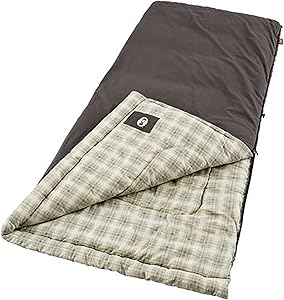
- Insulation: 5 lbs. Holofill 808
- Dimensions: 84 x 40 inches (Big & Tall)
- Temperature Rating: 10°F
- Liner: Synthetic flannel
The Coleman Heritage is a heavy-duty 4-season sleeping bag specifically designed for those who need extra room. Its Big & Tall dimensions accommodate campers up to 6 feet 5 inches tall, offering far more interior space than a traditional mummy bag. With five pounds of Holofill 808 insulation, it is built to keep you warm in temperatures as low as 10 degrees Fahrenheit.
Unlike lightweight backpacking bags, this model features a heavy-duty cotton cover and a cozy flannel liner, making it feel more like a traditional bed than a technical piece of gear. It also includes the Wrap ‘N’ Roll system for easy storage and FiberLock technology to keep the insulation from shifting. While too bulky for a backpack, it is an outstanding choice for cold-weather car camping.
Pros: Extremely spacious, very warm for winter use, and soft flannel lining.
Cons: Too heavy and bulky for backpacking; strictly for car camping use.
6. HiZYNICE Cold Weather Sleeping Bag

- Dimensions: 90 x 39 inches
- Lining: 100% cotton flannel
- Extreme Rating: 0°F
- Versatility: Can zip two together
The HiZYNICE Cold Weather Sleeping Bag is designed for campers who prioritize roominess and warmth. Its oversized “Big & Tall” dimensions make it a perfect choice for side sleepers or larger individuals who find standard bags suffocating. The interior is lined with soft 100% cotton flannel, providing a cozy, skin-friendly texture that synthetic liners often lack, while the outer shell is waterproof for added protection.
This bag is remarkably versatile, featuring anti-snag zippers that allow for ventilation at the top or bottom. It can even be fully opened to serve as a flat mat or zipped to another bag to create a double-sized sleeping area. While it is rated for extreme cold, its comfort rating of 30 degrees makes it a reliable 3-season companion for those who enjoy the luxury of extra space.
Pros: Very large dimensions, comfortable flannel interior, and dual-purpose as a mat.
Cons: Heavy weight and large packed size make it unsuitable for hiking.
See the HiZYNICE Cold Weather Sleeping Bag
7. Coleman Brazos

- Temperature Rating: 30°F
- Dimensions: 75 x 33 inches
- Construction: Fiberlock insulation system
- Feature: Thermolock draft tube
The Coleman Brazos is a classic, budget-friendly sleeping bag designed for casual camping trips in moderate weather. Rated for 30 degrees Fahrenheit, it features a Thermolock draft tube along the zipper to prevent heat loss, ensuring you stay warm throughout the night. The Fiberlock construction is a key design element, as it prevents the insulation from shifting and creating cold spots over time.
Packing this bag is straightforward thanks to built-in fasteners that lock the bag in place as you roll it up. It also includes a no-snag zipper, which is a welcome feature at this price point. While it is sized for campers up to 5 feet 11 inches, it offers the ability to zip two bags together, making it a flexible and affordable option for families or couples heading to the campground.
Pros: Very affordable, effective draft tube, and simple to roll up.
Cons: Not long enough for tall campers and not suitable for freezing temperatures.
8. JEAOUIA Sleeping Bag

- Weight: 3.3 lbs
- Comfort Range: 50°F – 68°F
- Material: Waterproof polyester shell
- Dimensions: 31.5 x 86.6 inches
The JEAOUIA Sleeping Bag is a lightweight and compact option tailored for mild weather adventures, such as summer camps, office crashing, or indoor use. Its 3-season design is best suited for temperatures between 50 and 68 degrees Fahrenheit, making it a great choice for warmer nights where a heavy bag would be overkill. The waterproof polyester shell and hollow fiber filling provide a breathable yet protective environment.
A standout design choice is the inclusion of a separate zipper at the foot, allowing for custom ventilation if you get too warm. The drawstring hood also helps seal in heat around the head on cooler nights. Given its low weight and easy-to-clean materials, it is a practical choice for kids’ trips or as an emergency blanket to keep in your vehicle for unexpected situations.
Pros: Very lightweight, affordable price, and separate foot zipper for ventilation.
Cons: Very thin insulation not suitable for cold nights or high-altitude camping.
9. Teton Sports LEEF

- Design: Roomy mummy shape
- Included: Compression sack
- Temp Options: 0, 20, or 30 degrees
- Material: Durable polyester shell
The Teton Sports LEEF is an ultralight sleeping bag designed for adults who need a balance of packability and interior space. Unlike traditional mummy bags that can feel like a straightjacket, the LEEF offers a slightly roomier cut that allows for more natural movement. This makes it an excellent option for backpackers who want to save weight without sacrificing the ability to change positions during the night.
Because it comes in multiple temperature ratings and sizes, it is easy to find the specific model that fits your typical camping environment. The efficient insulation allows the bag to pack down remarkably small in its included compression sack, fitting easily into most hiking backpacks. It is a highly reviewed piece of gear that offers professional-grade features at a price accessible to hobbyist hikers.
Pros: Multiple temperature options, roomier than standard mummy bags, and highly compressible.
Cons: Synthetic fill may lose loft over several years of heavy use.
10. ZOOOBELIVES Down Sleeping Bag

- Fill: 35oz of 550+ fill power down
- Lower Limit: 10°F
- Shell: 20D ripstop nylon
- Zipper: YKK anti-snag
The ZOOOBELIVES Down Sleeping Bag offers the premium warmth of down insulation at a fraction of the cost typically seen in high-end outdoor stores. Filled with 35 ounces of 550+ fill power down, it provides impressive loft and heat retention for crisp fall and winter nights. It features an anatomic 3D footbox and an insulated draft collar, both of which work together to eliminate cold spots.
This bag is highly functional with camp-ready features like a 20D ripstop nylon shell and a smooth YKK zipper. It manages to remain relatively lightweight while providing enough room for campers to feel comfortable. With the ability to zip left and right models together, it is also a fantastic choice for couples looking for a warm, down-filled double sleeping solution for their next backpacking trip.
Pros: Real down warmth for a low price, high-quality YKK zippers, and very warm.
Cons: Heavier than premium high-fill down bags and shell is somewhat thin.
See the ZOOOBELIVES Down Sleeping Bag
The Ultimate Guide to Choosing and Using Bikepacking Sleeping Bags
Bikepacking is an exhilarating blend of mountain biking and self-supported camping. Unlike traditional bicycle touring, which often relies on panniers and paved roads, bikepacking takes you off the beaten path and onto singletrack trails, gravel grinds, and remote forest roads. Because space on a bike frame is extremely limited, every piece of gear must be scrutinized for its weight, packability, and performance. Perhaps no piece of gear is more critical to your recovery and enjoyment than your sleeping bag.
When you are burning thousands of calories a day pedaling over rugged terrain, a good night’s sleep isn’t just a luxury; it is a safety requirement. A quality bikepacking sleeping bag needs to strike a delicate balance between keeping you warm and disappearing into your handlebar roll or seat pack. This guide will walk you through everything you need to know to select the perfect sleep system for your next two-wheeled adventure.
Understanding the Bikepacking Constraint: Space and Weight
The primary difference between a general camping sleeping bag and one designed for bikepacking is the packed volume. On a bicycle, you don’t have the luxury of a large trunk or a massive 70-liter backpacking pack. Most bikepackers utilize a seat pack (8-15 liters) or a handlebar roll (10-20 liters) to store their sleep system. If your sleeping bag takes up 12 liters of space, you will have nowhere to put your tent, clothes, or food.
Weight is the second major constraint. Every extra gram you carry must be winched up climbs and stabilized on technical descents. A heavy bag changes the handling of the bike, making it feel sluggish and less responsive. Therefore, bikepacking bags tend to lean toward minimalist designs, high-quality materials, and efficient shapes.
Down vs. Synthetic Insulation
The first decision any bikepacker must make is the type of insulation. This choice affects the price, the weight, and the bag’s performance in different weather conditions.
Down Insulation
Down is the gold standard for bikepacking. It consists of the fluffy undercoating of ducks or geese. Its primary advantage is its incredible warmth-to-weight ratio and its compressibility. A high-quality down bag can be squished down to the size of a large grapefruit, making it ideal for cramped bike bags.
However, down has one major weakness: moisture. If a down bag gets wet, the feathers clump together, losing their loft and their ability to trap heat. While many modern bags use “Hydrophobic Down” (treated with a water-resistant coating), you still need to be diligent about keeping it dry. Down is also significantly more expensive than synthetic alternatives.
Synthetic Insulation
Synthetic insulation is made of polyester fibers designed to mimic down. The biggest advantage here is resilience. Synthetic bags continue to provide some warmth even when damp and they dry much faster than down. They are also hypoallergenic and much more affordable.
The downside for bikepackers is that synthetic insulation is bulkier and heavier. It does not compress nearly as well as down, which may force you to use a larger, more cumbersome bag on your handlebars. For budget-conscious riders or those heading into extremely swampy or wet environments, synthetic remains a viable choice.
Temperature Ratings Explained
When looking at a sleeping bag, you will see several numbers. Understanding the ISO or EN rating system is vital. Usually, these ratings include a “Comfort,” “Limit,” and “Extreme” temperature.
- Comfort: The temperature at which a “standard” sleeper can sleep comfortably in a relaxed position.
- Limit: The temperature at which a “standard” sleeper can sleep for eight hours in a curled position without waking up.
- Extreme: A survival rating only. You will be very cold and at risk of frostbite; this is not a temperature you want to actually sleep in.
For bikepacking, it is generally wise to choose a bag with a comfort rating about 10 degrees lower than the coldest temperature you expect to encounter. Mountain environments are notorious for sudden temperature drops at night.
Bag Shapes and Designs
The shape of your bag dictates how much air your body has to heat up and how much fabric you have to carry.
The Mummy Bag
The mummy bag is the most common choice for bikepackers. It is tapered at the legs and wide at the shoulders, with an integrated hood. This shape is the most thermally efficient because it minimizes the dead air space inside the bag. By removing excess fabric at the corners, it also reduces weight and packed volume.
The Quilt
In recent years, many ultralight bikepackers have switched to quilts. A quilt is essentially a sleeping bag without a back or a hood. The logic is that the insulation you lay on top of in a sleeping bag is compressed by your body weight, rendered useless for trapping heat. By removing the back and the hood, quilts are significantly lighter and more packable than mummy bags. They strap directly to your sleeping pad to seal out drafts. This is an excellent option for those looking to shave every possible gram.
The Footbox Design
Pay attention to the footbox. Some bags feature a “3D” or “Anatomic” footbox that allows your feet to rest in a natural upright position without tensioning the fabric. This prevents your toes from compressing the insulation and creating cold spots at the end of the bag.
Essential Features for the Trail
While minimalism is key, a few specific features can greatly improve your experience on a multi-day ride:
- Anti-Snag Zippers: There is nothing more frustrating than trying to zip up in the dark and having the fabric get stuck. Look for zippers with guards.
- Draft Collars and Tubes: These are insulated tubes that run along the zipper and around the neck to prevent heat from escaping through the gaps.
- Stash Pockets: A small internal pocket is perfect for keeping your phone or headlamp battery warm (cold temperatures drain batteries quickly).
- Compression Sacks: Most bags come with a stuff sack, but a dedicated compression sack with straps can help you reduce the volume even further to fit into tight frame spaces.
The Importance of the Sleeping Pad
It is a common misconception that the sleeping bag does all the work. In reality, your sleeping bag and sleeping pad work as a system. The ground will leach heat away from your body much faster than the air will. Even the most expensive 0-degree bag will feel cold if you are sleeping on a thin, uninsulated pad. Look for a pad with a high R-value (a measure of thermal resistance) to complement your bag, especially when camping on cold soil or rock.
Maintenance and Storage
To ensure your bikepacking sleeping bag lasts for years, proper care is essential. Never store your sleeping bag in its compression sack long-term. Doing so will crush the insulation fibers (down or synthetic) and permanently reduce its loft and warmth. Instead, store it in a large, breathable mesh or cotton laundry bag in a dry place.
When on the trail, try to air out your bag every morning. Moisture from your breath and body can accumulate in the insulation. Even 15 minutes of sun exposure while you eat breakfast can help dry out the bag and maintain its thermal efficiency for the next night.
Final Thoughts
Choosing a bikepacking sleeping bag is a personal decision that depends on your budget, your bike’s carrying capacity, and the environments you love to explore. While the initial investment in a high-quality down mummy bag or quilt can be steep, the reward is a lighter bike, a faster ride, and most importantly, a restorative night of sleep under the stars. By focusing on compressibility, an accurate temperature rating, and a weight that suits your riding style, you’ll be well-equipped to tackle any trail the world throws at you.
Remember: the best bag isn’t necessarily the most expensive one—it’s the one that fits in your pack and keeps you warm enough to wake up excited for another day in the saddle.
html>